
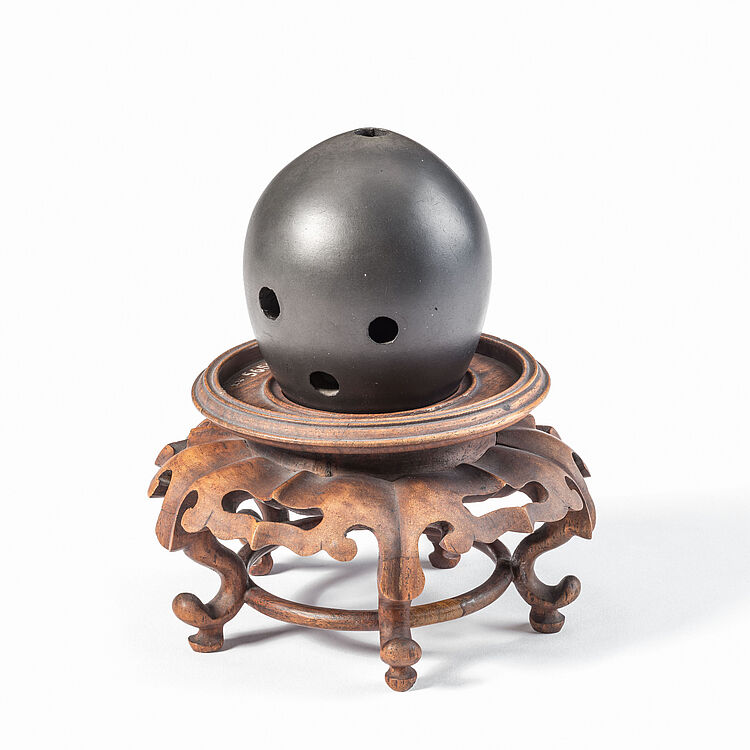
 Bild: Deutsches Museum, München
Ort: Seminarraum Forschung I (im Bibliotheksbau)
Link zur Online Teilnahme:
Beitreten Zoom Meeting:
https://zoom.us/j/7543392022?pwd=idcp61CSSfxbZPHaNZaNqpKakOngRH.1&omn=94073510221
Meeting-ID: 754 339 2022
Kenncode: 624841
Prof. Dr. Joys Cheung; Silke Berdux:
Artefacts and musical memory in Chinese modernity: evaluating the rare instrument collection of the Datong Music Society in the Deutsches Museum (1926)
Abstract:
History was a challenge in Chinese musical modernity. While reformers believed in the power of music as ancient documents taught, memory of the ideal music played in antiquity was lost. A century ago, against the trends of adopting Western models for making new Chinese music, Datong Music Society (est. 1919) maintained the native models, chasing musical memory of the past in order to present new music rooted in local history. A core program of Datong during its heyday in the 1920s and 1930s in Shanghai was the making of ancient-styled musical instruments for exhibition and their selective use for performance, a pioneering effort that remained obscurely known until recently. The rare collection of Datong instruments in the Deutsches Museum is crucial for recovering Datong’s creative revivalism. Originated as a gift from Datong to the Deutsches Museum, the rare collection consists of eleven Chinese musical instruments that arrived in 1926 (one among them was lost). For a long time, the name of the Deutsches Museum was lost track in the Chinese music scholarship because of its changed translation. It was only through the inquiry of Joys Cheung, followed by the confirmation of Silke Berdux, in early 2023, that the gift collection was “found.” The discovery of the rare instruments provides new impetus to understand the relation between artefacts, musical memory, and reform in Chinese modernity. They represented the earliest formal experiments in Datong’s productions, which integrated imitating the ancient models with fantasy features. The collection also predated Datong’s large- scale exhibition of musical instruments held in Shanghai in 1931, which is preserved mainly in photos in China. In the Deutsches Museum, the instruments had not been stored and displayed as a group, but were assigned to the different instrument groups according to the European system: flutes, reed instruments from the aerophones, plucked string instruments from the chordophones, and idiophones. The knowledge about the instruments as a group was lost. Since Berdux confirmed their archived records, the instruments and their context are researched in cooperation between Berdux, Cheung, experts from Shanghai and Europe, and Ruirui Ye, who joined the Deutsches Museum in December 2025. This collaborative lecture evaluates the Datong instruments in the Deutsches Museum as providing the missing objects that illuminate the Chinese creative project of memory reconstruction and “heritage” invention. It provides a research context for the upcoming exhibition of the rare Datong musical collection in the Deutsches Museum between November
Short Bio:
Joys H.Y. CHEUNG (Ph.D. in Musicology/Ethnomusicology, University of Michigan; M.M. in Ethnomusicology, University of Texas) is an Associate Professor at the Graduate Institute of Ethnomusicology, National Taiwan Normal University. Her research has focused on the field of “music” in Chinese modernity emerging from interwar Shanghai, including issues of translated modernity, networks, the sublime, qin listening, historiography, and heritage negotiations. Her recent publications include The Art Song of East Asia and Australia, 1900-1950 (co-edited with Alison Tokita, Routledge, 2023), and “Making Chinese Instrumental Relics in Pre-UNESCO Modernity: Datong Music Society’s ‘Heritage’ Project” (Journal of Music Research 音樂研究, Taipei). Her article “Riding the Wind with Mozart’s ‘Jupiter’ Symphony: The Kantian and Daoist Sublimes in Chinese Musical Modernity” (Music & Letters, UK, 2015) received the Rulan Chao Pian Publication Prize in 2016. She was a scholar-in-residence at the Deutsches Museum, May to July 2025.
Musicologist Silke Berdux is curator of the musical instrument department of the Deutsches Museum in Munich since 2000. She has developed and supervised a wide range of projects on the documentation, preservation and display of musical instruments. In the focus of her scientific work are the history of the fortepiano around 1800, speaking machines, the 19th- century flute as well as piano rolls and electronic instruments and studios. With her team she realized the new permanent exhibition of musical instruments in the Deutsches Museum which opened in July 2022. Her work currently focuses on the instruments of the Datong Music Society, with a special exhibition currently in development.