
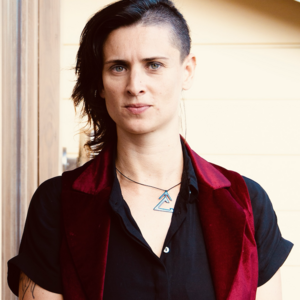
Camila Nobrega Rabello Alves
ForschungsinstitutScholar in Residence
E-Mail camilanobrega@protonmail.com
Zeitraum: 15. August bis 15. November
What if hydropower dams could tell their stories? Interrogating energy generation through the Deutsches Museum collection: from the Amazon Region to Munich, Germany
Short CV
Camila Nobrega is a researcher, transmedia journalist, documentarist, and writer, focusing on feminist and queer perspectives in social-environmental conflicts and infrastructure megaprojects. With nearly 20 years of experience those topics, Camila began as a full-time reporter and international correspondent while concurrently developing her academic research. She/ They engage in transdisciplinary and cross-border collaborations that extend beyond
traditional academic settings, encompassing museums, theaters, and newsrooms. Camila is also particularly interested in public spaces as platforms for knowledge production and circulation. Their teaching experience includes positions at the Free University of Berlin (Germany) and the University of Applied Arts Vienna (Austria). From 2024 to 2026, she was an Associate Researcher in the Department of Political Science at TU Dresden, focusing on Political Theory and the History of Political Thought. The position was part of the international research project "Push Backlash." Since 2015, Camila has initiated an ongoing long-term project called "Beyond the Green," aimed at bridging academia, investigative environmental journalism, documentary, and artistic expressions. This project functions as a Laboratoria for cross-border and hybrid collaboration.
Short description of the project
This research explores the historical and societal narratives encapsulated in hydropower dams, interrogating their representation across various mediums. By tracing the genealogical origins of these structures, the project examines their implementation and impact in diverse contexts. Dams are viewed as critical sites reflecting technological shifts and societal dynamics throughout history, influencing our bodies and experiences in different locales. Delving into methods like archive review and artifact engagement at the Deutsches Museum, audio recordings and archival material from Brazil and Germany in which the author has worked with in the last 10 years, the project aims to question: How do hydropower-related objects convey complex power generation narratives while carrying societal memories across time and geography?
With rivers increasingly altered by dam construction, public debates arise about their ecological and social implications, evident in discussions about decommissioning dams in Germany for instance and, on the other hand, ongoing projects in the Brazilian Amazon. This research adopts a transdisciplinary lens to engage with these social-environmental conflicts while exploring evolving representations and relational processes. Anticipated outcomes include a transmedia installation combining text, audiovisual elements, and community narratives, fostering reflection on the interplay between communities, cities, and their rivers. Collaborative efforts with the Deutsches Museum will enrich visitor engagement, inviting reflection on personal and communal relationships with powerful stories and possibilities of investigation behind and in relation with artifacts.