Photo: Deutsches Museum | Konrad Rainer
A highlight from the collection
Tide-predicting machine
Reliable information about high and low tides was vital for shipping. Special calculating machines were developed for this purpose from the 19th century onwards. This extraordinary example is the largest of its kind.
Tide forecasting – a feat of engineering
Tides are caused by physical forces acting on the Earth’s bodies of water. They manifest themselves in the periodic rise and fall of sea level and in currents created by the varying shapes of coastlines, islands and ocean depths. The tides have a major impact on shipping, which is why machines have been designed since as early as 1872 to predict these physical forces and calculate the tides in a harbour. The world’s largest tide-predicting machine was built by Dr Heinrich Rauschelbach in 1938 and has been part of the Deutsches Museum’s collection since 1976.
What makes predicting the tides so difficult?
Tides refer to the periodic rise and fall of sea level. This is caused by what are known as tidal forces. Firstly, these are the gravitational forces exerted by the Moon and the Sun on the Earth’s moving bodies of water. These are raised by the gravitational forces whilst the Earth rotates steadily on its own axis beneath them. The Moon, as our nearest celestial body, has the greatest influence here. It orbits the Earth in a nearly elliptical path, and so its distance from the Earth changes over the course of a month. Secondly, there are the centrifugal forces caused by the circular motion of the Earth and the Moon around a common centre of gravity, as well as by the Earth and the Moon’s orbit around the Sun over the course of the year. These tidal forces caused by the Moon and the Sun add up. The individual factors that influence the tide – that is, the alternation between ebb and flow – are known as partial tides.
From the Baltic Sea to the Bay of Fundy
No coastline on Earth is without tides. However, there are significant differences in tidal range – the difference between low and high tide – ranging from a few centimetres on the Finnish Baltic coast to 21 metres in Canada’s Bay of Fundy. This is because tidal waves manifest themselves not only in the changing sea level but also in a horizontal tidal current, the extent of which depends on the coastline in question. If the Earth were a sphere completely covered by water of uniform depth, the tidal forces could be calculated in full, as demonstrated by the findings of Isaac Newton (1642–1727) and Pierre-Simon Laplace (1749–1827). However, continents, islands and varying water depths significantly alter the astronomically determined tides. A general formula containing only astronomical data does therefore exist, but no general mathematical expression can take all location-dependent factors into account. The tides of the sea are therefore among the most complex phenomena in geophysics.
On behalf of the Kriegsmarine
In 1935, the High Command of the Kriegsmarine commissioned the calculator from the German Hydrographic Office in Hamburg and the firm Mechanoptik near Potsdam for 195,000 Reichsmark. Although there had been an earlier German tide calculator dating from 1916 (now in the German Maritime Museum in Bremerhaven), its results were not precise enough. In view of the possibility of war, the Kriegsmarine required a precise and reliable machine, as accurate knowledge of the ebb and flow of the tides – particularly on coasts with highly variable tidal ranges – was of decisive military advantage.
Rauschelbach stands in front of his tidal calculator and adjusts the printing mechanism. Photo: Deutsches Museum
Heinrich Rauschelbach and his computing colossus
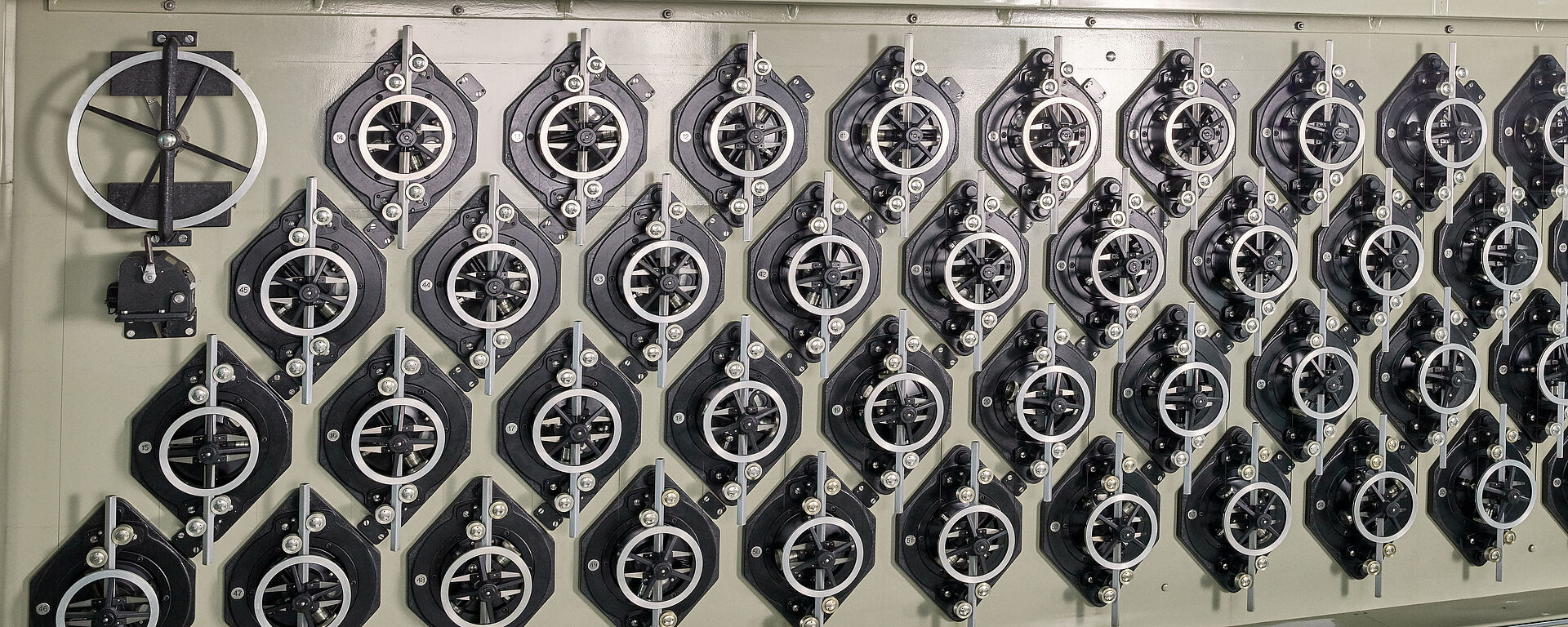
In 1935, the astronomer and tidal researcher Heinrich Rauschelbach (1888–1978) began developing a new tide-predicting machine. Under his supervision, a colossal machine 7.5 metres long and 2 metres high was built, featuring no fewer than 62 partial tides. Half of these represented astronomical tides, such as the semi-diurnal principal lunar tide or the semi-diurnal principal solar tide. The other half allowed for so-called shallow-water tides, which have a considerable influence on the overall tidal wave, particularly in shallow coastal areas. These consist of one or more astronomical tides and must be determined for each location over a longer period of time using hourly water-level measurements.
For each tidal gear, a partial wave was calculated from the total tidal wave. To this end, the phase and amplitude of each wave motion could be adjusted using micrometre screws. To sum the wave motions of all tidal mechanisms into a single composite wave, they were connected by an artificially aged steel strip. In the printer mechanism of the calculator, a stylus then recorded the mechanically summed wave onto a sheet of paper. On the reverse side, each tide was set with a phase shift of 90°, so that the reverse side of the calculator computed the first derivative of the front side. This helped in analysing the tidal curve to quickly read off the times of the extreme values for low tide and high tide. After the world’s largest tide-predicting machine had been transported to the Deutsches Museum, it could still be admired in action for a few more years. However, as early as 1980, its maintenance-intensive operation had to be discontinued.
For today’s generations, this masterpiece of analogue precision engineering is almost inconceivable: we have small pocket calculators at our disposal for trigonometric functions, and complex tasks such as harmonic analysis can be modelled using the all-purpose computer. The era of large specialised calculators is long gone.
Tide-predicting machine – Key Figures
- Dimensions (H × W × D): 200 × 750 × 110 cm
- Weight: 11 t
- Partial tides: 62
- Calculation time for 1 year: 20 hours