Photo: Deutsches Museum
Highlight from the collection
Otto Lilienthal's 'Normal-Segelapparat'
The dream of flying and what was left of it: the 'Normal-Segelapparat' is the world's first series-produced aeroplane - and the first example in the aviation collection at the Deutsches Museum. This Lilienthal glider tells an exciting story.
Otto Lilienthal was not the first person to try flying. But he was the first to successfully realise the principle of bird flight. He proved that an aeroplane only flies when its wings are curved like those of a bird. Only this deflection of the airflow creates lift and propulsion. Otto Lilienthal flew the hang glider, which is in the possession of the Deutsches Museum, himself from 1894 onwards. All the details come from Lilienthal's Berlin machine factory. The inventor had dedicated his entire life to the desire to fly.
The Lilienthal glider
“Our cultural life suffers from the fact that it only takes place on the surface of the earth. The sealing off of the countries, the imposition of customs duties and the impediment of traffic is only possible because we do not rule the air as freely as the bird. ”
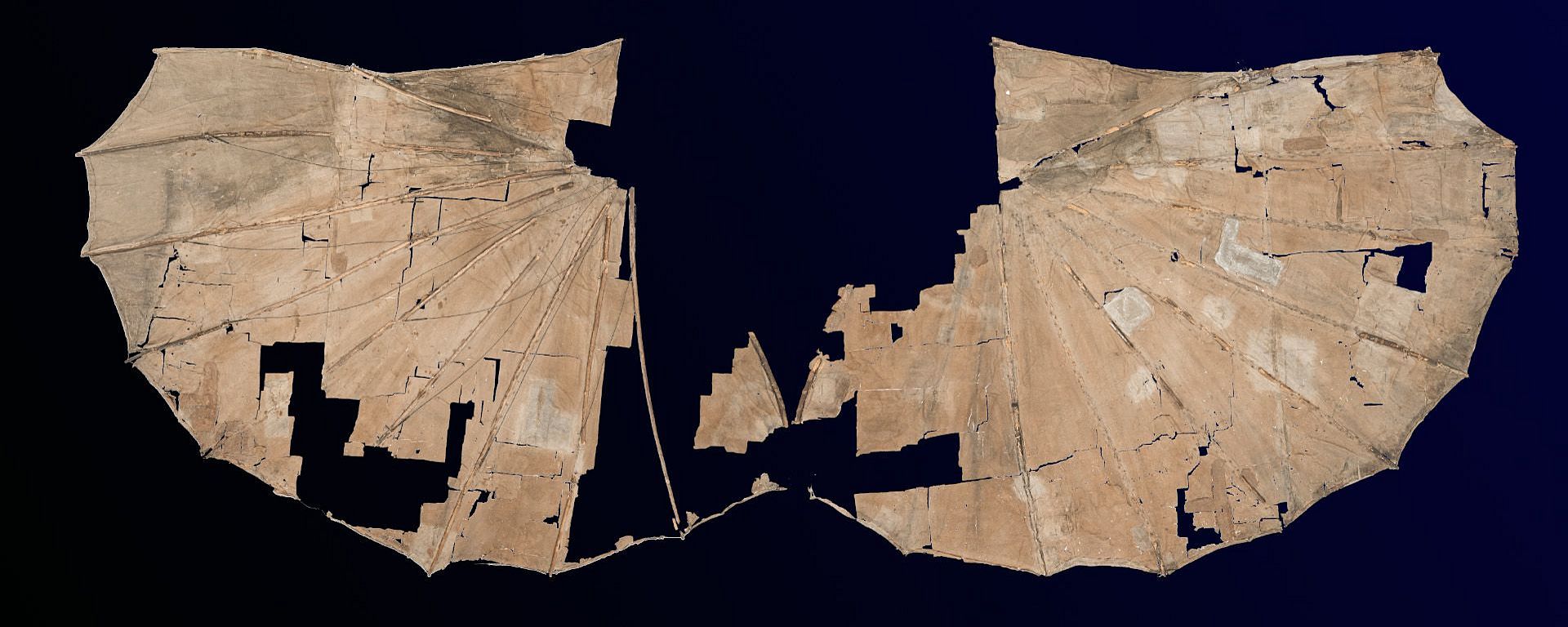
The glider in the Deutsches Museum is probably the one in which Lilienthal flew from the "Fliegeberg" in Berlin-Lichterfelde in 1894 - and one of only five examples still in existence worldwide. What makes this glider so unique is that it still has large parts of its original covering and has never been extensively "repaired". And so you can see exactly how Lilienthal worked with which materials on this original.

The 'Normal-Segelapparat' with frame cross, frame ring and tail unit. Photo: Deutsches Museum, Hubert Czech
Drawing of the 'Normal-Segelapparat' by Otto Lilienthal, 1895. "Normal-Segelapparat with a sail area of 13 square metres. No. 10" Photo: Deutsches Museum
The 'Normal-Segelapparat' from the Otto Lilienthal machine factory
Throughout his life, Lilienthal endeavoured to pass on his enthusiasm for flying. After years of experimentation, he had created a standard model, the 'Normal-Segelapparat', which he found suitable for "flying sports". The central element of the wooden aeroplane construction is the frame cross with the frame ring in which the glider was positioned. The wings extend to both sides with ribs made of willow rods. The tail unit is attached to the centre rear of the frame ring. It consists of a bamboo rod and the vertical surface, over which a movable horizontal surface was folded. The vertical tail unit positioned the glider in the wind and the horizontal surface stabilised the flight attitude. The frame ring, the wings and the tail surfaces were covered with cotton fabric, which was glued and nailed on. The upper bracing was made of cord, the lower bracing of metal wire, the length of which was adjusted with turnbuckles. For the flight, the folded glider was transported to a hill, assembled on site and tensioned with tensioning wires. The correct curvature of the wing surfaces was achieved by inserting four curved, wooden profile rails on the upper side of the wing. To take off, the pilot carried the aircraft to the take-off point, ran into the wind, lifted off and, ideally, touched down again with his feet. Control was achieved by shifting the centre of gravity with targeted body movements.
“The original Lilienthal glider will once again be the central exhibit in the 'Historic Aviation' exhibition on Museum Island”
'Normal-Segelapparat' - Key figures
- Wingspan: 6.7 m
- Wing depth: 2.6 m
- Mass: 20 kg
- Material: wood, cotton, hemp, steel, copper alloy
- Longest distance travelled: 250 m
- Flying speed: 14m/s
- Aircraft built: at least 12 units