
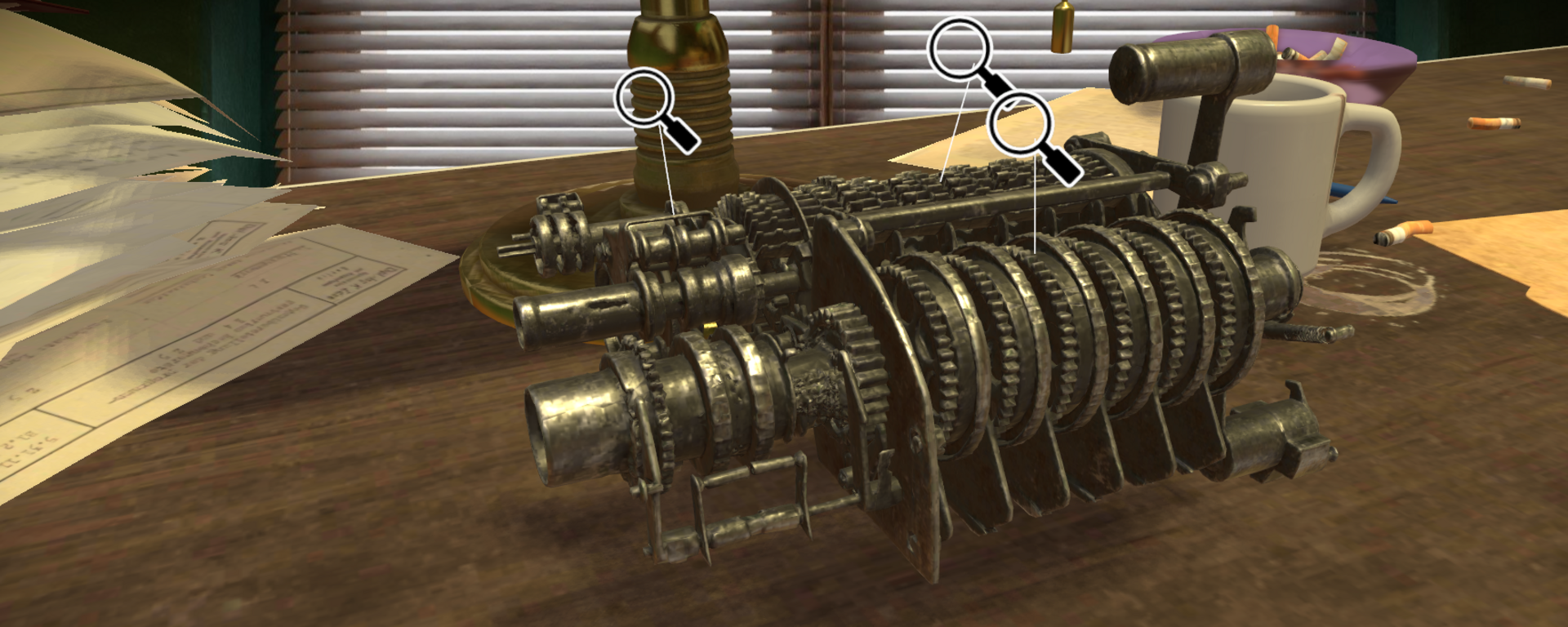
Photo: Deutsches Museum | Merlin Stadler
Online exhibition
Operation Rubicon
In this online exhibition, you can find out more about one of the most successful espionage operations in world history. Step into the exhibition space, where you’ll find secret documents and can discover cipher machines in the point-and-click mini-adventure.
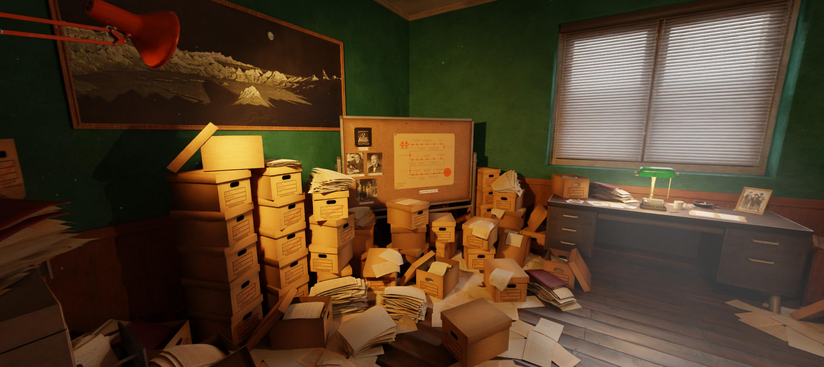
Rather than a traditional museum space, our digital exhibition offers a whole new world to explore. Photo: Deutsches Museum | Merlin Stadler
The digital exhibition ‘Operation Rubicon’ is set in a chaotic post-war office. Here, visitors can explore the history of Operation Rubicon in all its facets. Rather than attempting to recreate traditional museum spaces, the exhibition’s presentation enables visitors to immerse themselves in a world of their own. The application is modelled on point-and-click adventure games. In keeping with a secret espionage campaign, this theme is also reflected in the design: visitors must look around carefully to truly uncover the secret. The resulting sense of immersion is intended to spark an interest in exploring Cold War cryptology in greater depth.
Operation Rubicon: an online exhibition
In a chaotic post-war office, visitors can become spies themselves and explore the notes on the walls, as well as the machines and documents. Use your mouse to embark on a 360° discovery tour: you can examine anything marked with the magnifying glass icon in more detail. Simply left-click on the magnifying glass to do so.
To the online exhibition
Photo: Deutsches Museum
CX-52 cipher machine by Boris Hagelin
The centrepiece of the exhibition is Boris Hagelin’s CX-52 cipher machine. Along with many other cipher machines from the Deutsches Museum’s collection, this machine was scanned using computed tomography (CT) as part of the eHeritage research project ‘3D-Cipher’ and processed into a digital 3D model. Using such scan data, the interior of the machines – that is, the complex mechanical encryption algorithm – can be examined from all angles without causing any damage and virtually dismantled into its individual parts. To date, the Deutsches Museum has made the CT scan data available on a platform for research purposes.
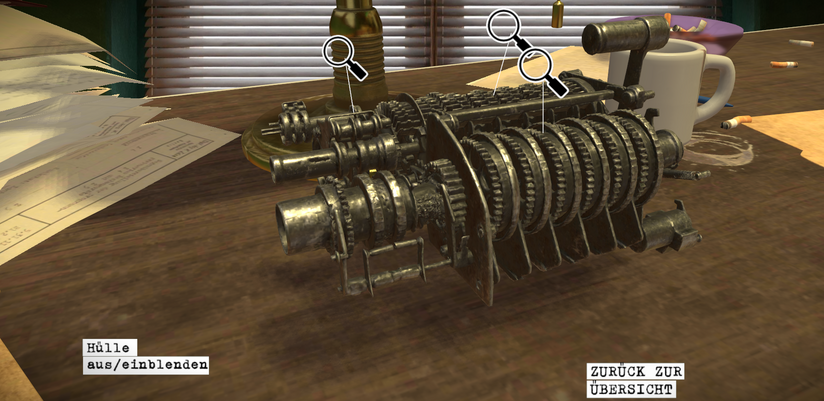
Photo: Deutsches Museum | Merlin Stadler
The "Operation Rubicon" intelligence scandal
‘Operation Rubicon’ is regarded as one of the biggest intelligence scandals of the last century, spanning from the 1970s into the 1990s. It was not until 2020 that it was revealed that the allied intelligence services, the German Federal Intelligence Service (BND) and the US CIA, had spied on more than 100 countries – using tampered encryption devices. The mechanical CX-52 cipher machines had been sold to the affected nations by the Swiss company Crypto AG. However, there were two different types of CX-52: a secure device and one that was easy to crack. The CIA and the BND then presumably simply intercepted the correspondence, which was believed to be well-encrypted. Countries classified as “vulnerable” were supplied with the interceptable machines, remaining unaware for a long time that it was possible to break the encrypted messages. The operation remained undetected for decades and is regarded as one of the most successful and secretive espionage operations of the Cold War.
Design and implementation of the online exhibition
Merlin Stadler worked as a student trainee on the 3D-Cipher research project at the Deutsches Museum. In 2024, he graduated from the Academy of Fine Arts in Munich as a master’s student and now works as an artist. During his time at the Deutsches Museum, he created the online exhibition ‘Operation Rubicon’.