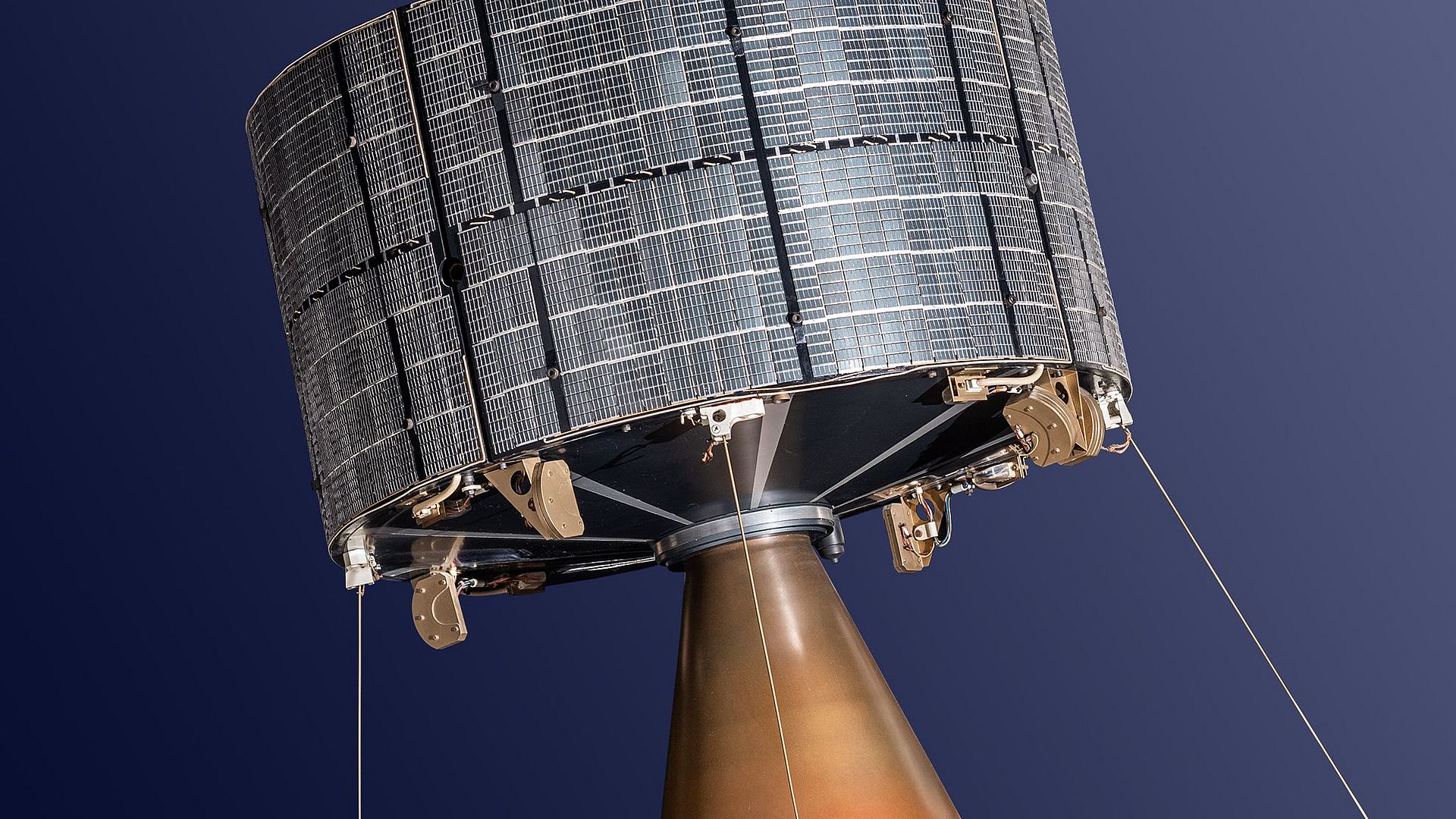
Photo: Deutsches Museum Muenchen | Christian Illing
Traffic Mobility Transportation
Astronautics – Journey into outer space
With numerous interactive exhibits, your journey from the early days of rocket technology to the Spacelab and satellites is guaranteed to be a truly “universal” experience!
“Nothing is impossible in the world, you just have to discover the means by which it can be done.
Es ist auf der Welt nichts unmöglich, man muss nur die Mittel entdecken, mit denen es sich durchführen lässt.”
Overview of the Exhibition
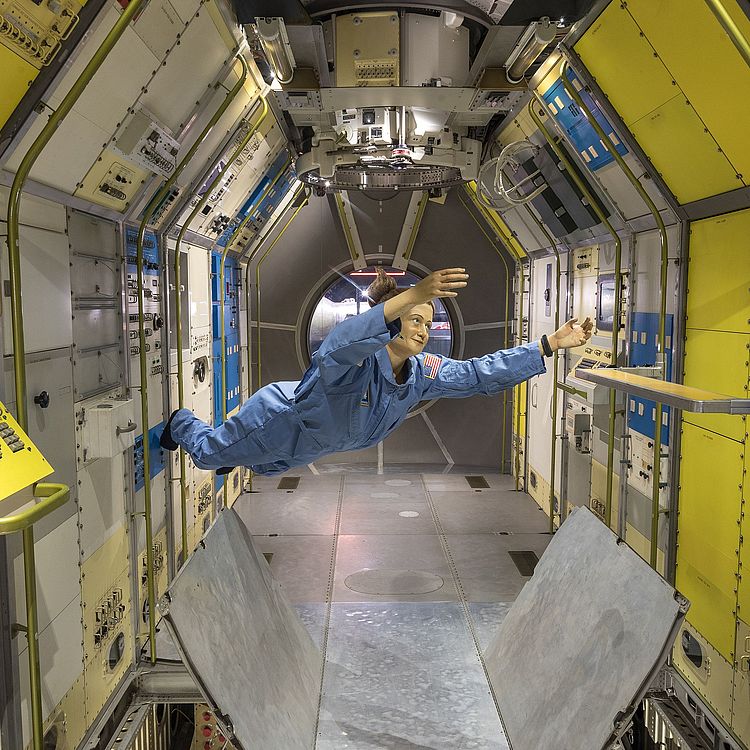
Countdown, launch, reaching and surviving in space: the Astronautics exhibition is laid out chronologically, corresponding to mankind’s journey into space. An overview of our solar system is followed by information about early rocket technology and the development of rocket engines and manned space flight, including the Spacelab. Next, the function of satellites and probes is explored, followed by remote sensing. Numerous exhibits and models, such as rocket sledges, spacesuits and the Helios probe, as well as media stations and interactive demonstrations, guarantee a truly “universal” experience!
Astronautics - Introduction
Completely detached from Earth: space travel, i.e. the transport of machines and people into space, is a young technological discipline. The fascination with the universe has existed since time immemorial, but we have only had the necessary knowledge, means and skills to overcome the limits of our planet for a few decades. Today, thousands of satellites orbit the earth, humans have been to the moon, they occupy a permanent outpost in a space station - and there are much more far-reaching plans for future journeys into the infinite expanses. The exhibition shows the development of space travel from the early ideas and innovations to today's importance as a central cornerstone in modern everyday life and for insights into life on Earth ... or perhaps elsewhere.
Highlights of the exhibition
Raketenwagen Rak.7. von Max Valier. Photo: Deutsches Museum | Konrad Rainer
Rocket car Rak. 7.
In 1930 and with the help of manufacturer Paul Heylandt, rocket pioneer Max Valier began to develop combustion chambers for liquid propellants. Valier had several test vehicles built. In the Rak.7, he used a combination of liquid oxygen and methylated spirits for the first time. In April 1930, he gave a public demonstration of the Rak. 7. in Berlin.
Satellit ASTRO-SPAS. Photo: Deutsches Museum | Reinhard Krause und Hubert Czech
ASTRO-SPAS satellite
The reusable satellite carrier ASTRO-SPAS carried measuring instruments for researching the Earth's atmosphere and flew into space four times with the space shuttle, most recently in 1997. ASTRO-SPAS carried out astrophysical measurements independently using the built-in instruments. Here it is on display with the built-in CRISTA telescope.
Atmosphären-Fahrstuhl. Photo: Deutsches Museum
Atmosphere lift
Climb aboard for a journey into space! The virtual lift simulates the ascent through the earth's atmosphere into space. The physical properties of the respective atmospheric layers - such as temperature and air pressure - as well as the weather phenomena that take place there are staged.
Moon-Talk with Charlie Duke
Former astronaut Charlie Duke was the tenth man on the moon with the Apollo 16 mission. As "Capcom", he maintained radio contact with the astronauts on the Apollo 11 mission on 20 July 1969 at the moment when Neil Armstrong spoke the legendary words "The Eagle has landed" as he landed on the moon. This video was made when Duke was a guest at the Deutsches Museum in June 2019. Parts of the Video are German only.
Facts and Figures
- Location: Level 2
- Exhibition area: 1125 m2
- Exhibits and models: approx. 290
- Demonstrations and interactives: 5
- Media stations: 19
- Dioramas: 3
When will this event take place?
Discover which activities are taking place by checking our daily programme, which is published at around 9.20 each day. Our programme changes daily and includes guided tours, demonstrations, science shows and hands-on activities for individual visitors and small groups of up to five people. All programme events are held in German. They begin either directly where the activity is set to take place or at a guided-tour meeting point in the relevant exhibition.
A View into the Astronautics Exhibition


You have specialist questions for our curator?
![Porträt eines Mannes mit unkenntlich gemachtem Gesicht, trägt ein schwarzes Sakko über weißem, feingemustertem Hemd; goldfarbene Anstecknadel in Form eines kleinen Flugzeugs am Revers, heller Hintergrund.]()
Andreas Hempfer
Curator
Aviation Department until 1945Deutsches Museum
80306 MunichTelephone +49 89 2179 643
Fax +49 89 2179 99350
Email a.hempfer@deutsches-museum.de