
Enigmas
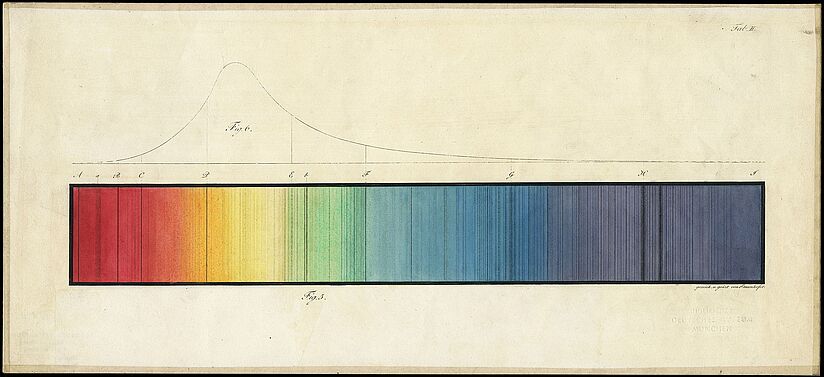
Colored Solar Spectrum (Replica, Original: Deutsches Museum Archive NL 014/029/1 GF). Photo: Deutsches Museum
To this day, Fraunhofer has left us with a number of enigmas and secrets. Two of these mysteries concern the famous hand-colored solar spectrum and the thumbnail-sized glass grating.
By Fraunhofer’s hand?
The colored band interrupted by black lines is probably the most famous image associated with Fraunhofer. It adorns book covers, exhibition posters, and postage stamps. This image captures Fraunhofer’s great discovery at a glance: dark lines revealing the chemical composition of the sun, the “secret code of the stars.” Yet only the position of the lines is scientifically relevant. The aesthetic coloration, however, has certainly contributed to the image’s fame.
It has long been assumed that the two colored spectra in the Deutsches Museum’s archive were colored by Fraunhofer himself. But critical inquiry is part of the nature of historiography. Through meticulous research, it has now been proven that Fraunhofer colored at least one spectrum himself. This finding was made possible by new sources: Two letters from Fraunhofer to the researcher Samuel Thomas Soemmerring had been rendered illegible by firefighting water during World War II. It was only in 2020, through an analysis using UV photography that the letters have become accessible again for historical research. The question of whose hand colored the spectra at the Deutsches Museum remains open. Perhaps material analyses of the pigments will yield new insights here.
The glass grating (Inv. No. 1977-1132) viewed with an electron microscope. The vertical stripes are spaced approximately 22.5 micrometers apart. Photo: Deutsches Museum | Harald Waßmer
Fine lines
Prisms are not the only tools that can disperse light into its color spectrum. This inconspicuous glass plate is a so-called diffraction grating. Light is deflected from its straight path by numerous straight, closely spaced grooves in the glass. The light waves resulting from this diffraction overlap in such a way that the color components are separated from one another.
Fraunhofer presumably began experimenting with gratings around 1819. For this, he initially used closely wound wires or threads. In his final process, he used a diamond tip to scratch several thousand ultra-fine grooves very close together onto glass plates: over 300 lines per millimeter!
To this day, several mysteries remain: What kind of apparatus did Fraunhofer use to perform this intricate work? And is this glass grating really made by Fraunhofer? Research on this is ongoing. This glass grating was examined using the Deutsches Museum's electron microscope and compared with glass gratings by Fraunhofer from the collection of the Münchner Stadtmuseum. There is strong evidence suggesting that this grating was indeed crafted by Fraunhofer, but definitive proof is still pending.