Publication
Nanotechnology and Biotechnology
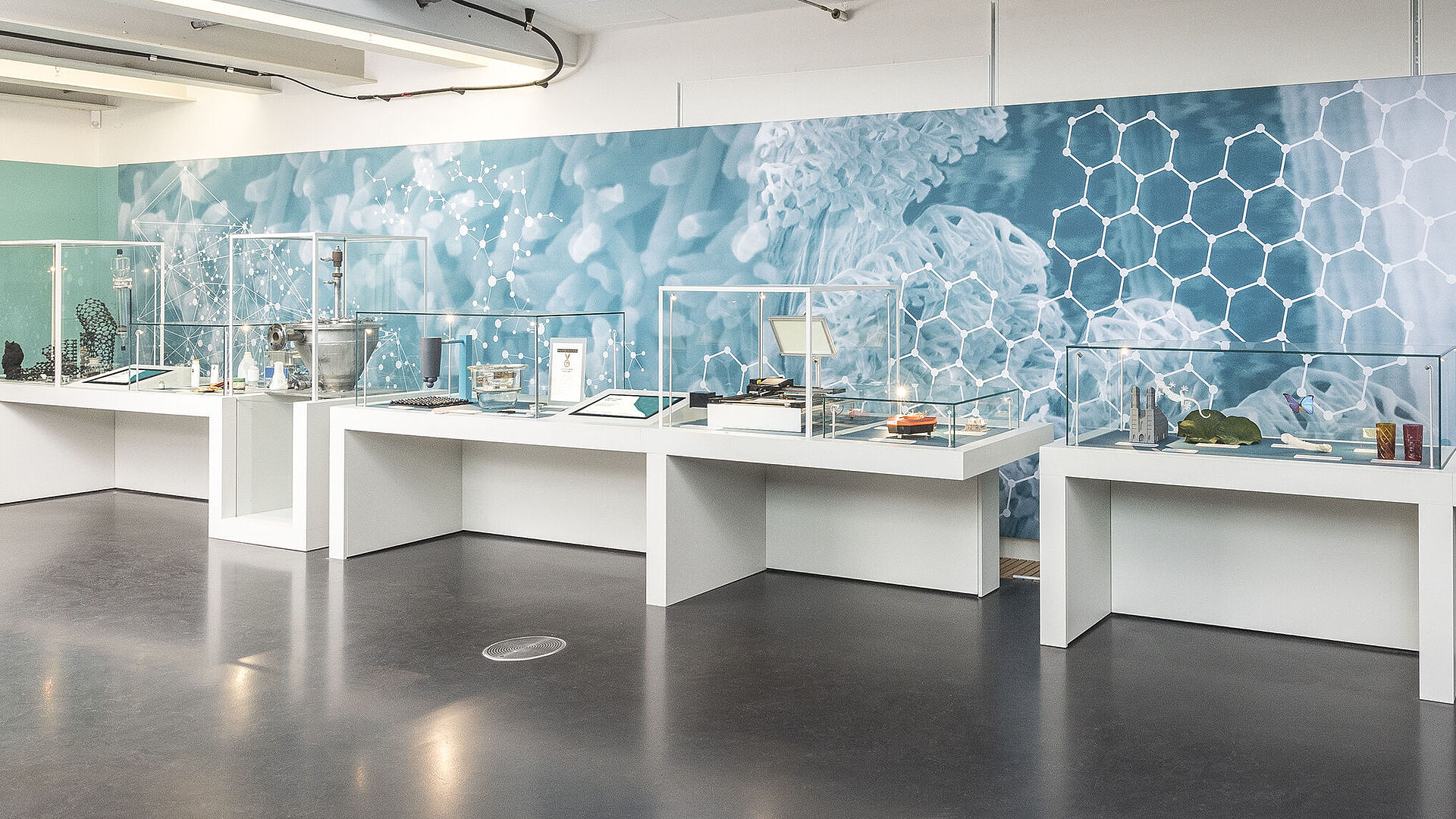
Welcome to the fascinating world of nanotechnology and biotechnology!

Photo: Deutsches Museum, München | Reinhard Krause

Natural Sciences
Two key technologies of the 21st century are making it possible to pursue entirely new approaches in science. Bacteria that produce human proteins? ‘Magic cotton wool’ that can absorb oil? It’s all possible! No wonder that many of the methods and devices developed in these fields of research have been honoured with the Nobel Prize. You’ll find highlights of these in this exhibition.
Extremely small and therefore extraordinary – for nanoparticles, the classical laws of physics apply only partially, or not at all. This gives rise to phenomena that exist only in the nanocosmos. And this world isn’t confined to the laboratory! We’ll show you some marvellous nano-effects found in nature, such as the lotus effect, where the leaves benefit from nano-sized wax particles on their surface, or the Morpho butterfly, whose nano-scale grooves make it shimmer blue. To visualise and investigate these phenomena, scanning probe microscopes were developed, which we explain using various exhibits.
Photo: Deutsches Museum, München | Reinhard Krause
Nanoparticles can be found in many everyday applications today; we showcase these in a dedicated display case, alongside the manufacturing methods used to produce these tiny all-rounders. We place particular emphasis on graphene and carbon nanotubes, which offer great potential for innovation and industrialisation, for example in the environmental sector.
The elucidation of the structure and function of genetic information – DNA – laid the foundations for modern biotechnology. The sequencing of an ever-increasing number of genomes has opened up new possibilities and avenues of research. Nowadays, a wide variety of methods for working with DNA are in use, which are being harnessed for innovations in medicine, research, plant breeding and industry.
Photo: Deutsches Museum, München | Reinhard Krause
Through historical and modern exhibits, you will first gain an overview of the development of sequencing instruments, then an insight into the various ways in which DNA can be manipulated, and finally we will introduce you to the potential applications of these new technologies in medicine.
First Scanning Tunneling Microscope by IBM, replica Photo: Deutsches Museum
In principle, structures in the nanoscale are too small to be observed under a light microscope. However, with the invention of the scanning tunnelling microscope in 1981, it became possible for the first time to image surface structures with atomic precision and even to manipulate them. A scanning tunnelling microscope works in a completely different way to a light microscope: the image is produced by scanning the surface of the sample line by line with an extremely fine metallic tip. For the development of this scanning tunnelling microscope, Binnig and Rohrer were awarded the Nobel Prize in Physics in 1986.
The Genome Sequencer 20 (manufactured in 2007) can be used to determine the sequence of a DNA fragment very quickly. Photo: Deutsches Museum
The information required to create a living organism is contained within a molecule known as DNA, which carries our genetic information. DNA consists of four building blocks, known as bases; two of these form a base pair. To be more precise, the information about our genes is therefore contained within the sequence of the individual base pairs. The countless possible sequences of these base pairs lead to the formation of thousands of different genes. Sequencing is the process of deciphering the order of these base pairs using sequencing machines. This genome sequencer analyses entire genomes in the blink of an eye. From the outside, it looks like an unimpressive grey box, but inside, several samples can be analysed in parallel runs – up to 20 million bases can be sequenced per run, in just 5.5 hours.
Welcome to the fascinating world of nanotechnology and biotechnology!
Kuratorin und Leitung Ausstellungsprojekte Sonderausstellung
Abteilung Nano- und Biowissenschaften
Fax +49 89 2179 99350
Email c.kolczewski@deutsches-museum.de
Kuratorin
Abteilung Life Sciences
Telephone +49 89 2179 551
Fax +49 89 2179 99350
Email m.kemper@deutsches-museum.de