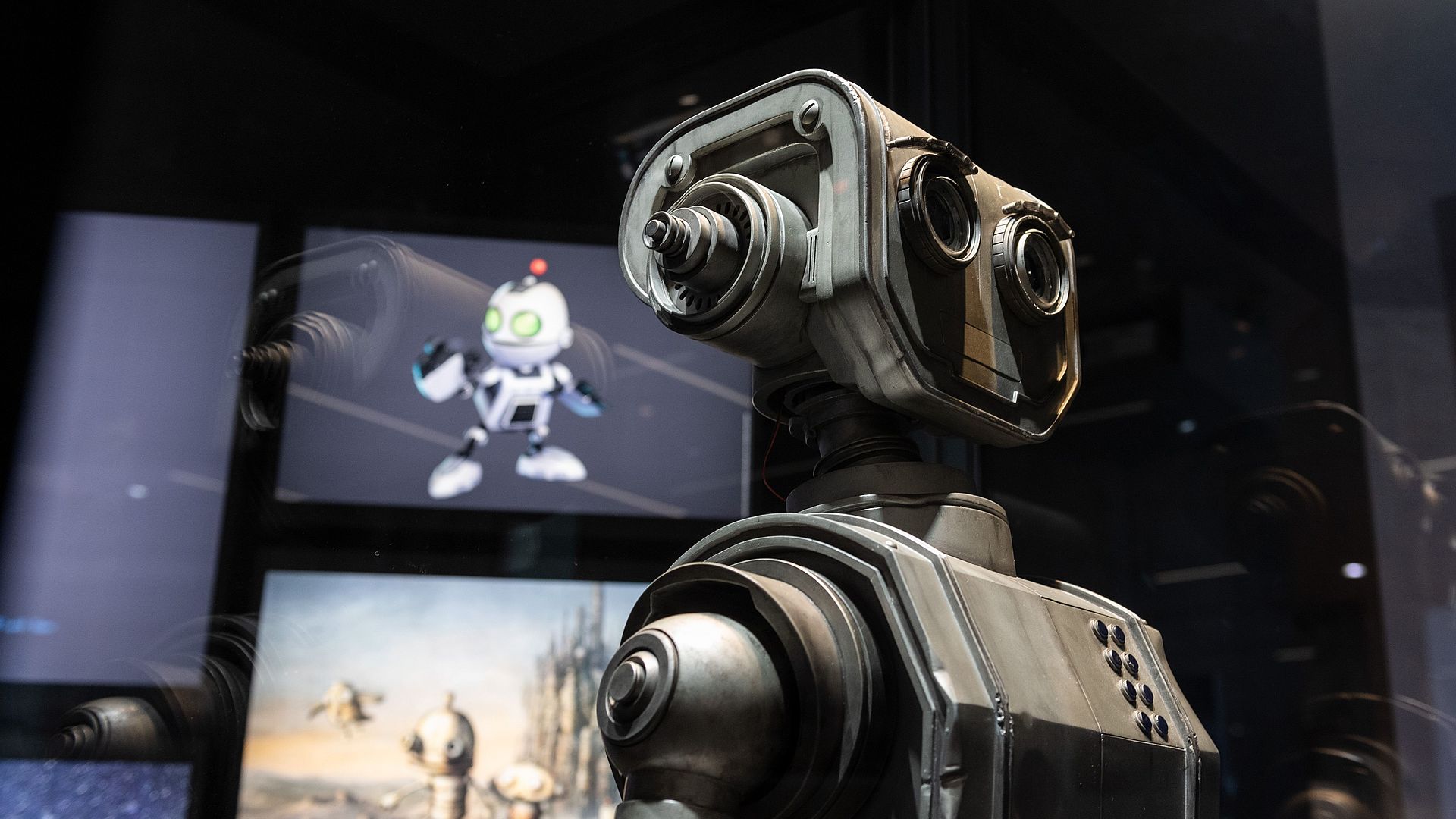
Photo: Deutsches Museum | Christian Illing
Work and Daily Life
What is Artificial Intelligence Allowed to Do?
The world is going digital: robots, AI, Big Data, social media and the Internet of Things are making our lives easier, taking away our work.
The new technologies are supposed to improve communication between machines, people and both worlds until they can no longer be separated. But they may also take away our work, collect sensitive data and be used for surveillance. The doll Cayla, for example, allows us to take a look into children's rooms from a distance. At a hands-on station, visitors can go in search of the AI among them. Gadgets make the partner tangible even in a long-distance relationship and a machine that is as human-like as possible with disturbingly real skin is supposed to replace a partner completely. What will the machine be allowed to decide for itself in the future? In which areas of life do we want to use robots and artificial intelligence - and in which not?
Insights
Work & Everyday Life: Living Through Digital Transformation
Our everyday lives are changing quietly, yet fundamentally. Machines are taking over tasks, algorithmic systems support or automate decisions, and connected devices accompany us from the moment we wake up until we go to sleep. The “Work & Everyday Life” exhibition area at the Deutsches Museum Nuremberg – the Museum of the Future explores what this transformation means for us.
The focus is not on a single technology, but on the interaction between many: robotics, artificial intelligence, digital communication, and control through smart everyday devices. These technologies promise to save time and reduce workloads, offering greater convenience and new freedoms. At the same time, they are deeply reshaping the world of work, private life, and social relationships. Many of these systems are already part of reality, while others are on the verge of implementation or still remain visions of the future.
The exhibition shows how technology shapes our daily lives: who works with whom – humans or machines? Who communicates with whom, and through which channels? And who collects what data in the process? Here, technology is not presented simply as an idea of progress, but as something that influences our actions, our decisions, and our self-image.
Who remains in control – us or the systems?
As digital technologies become increasingly integrated into work and private life, new questions arise. How much responsibility are we handing over to machines? If algorithms prepare or make decisions, who is liable when mistakes occur?
Ideas of closeness and trust are also changing. We speak to robots, form emotional attachments to machines, and allow smart devices into intimate areas of our lives. At the same time, the amount of personal data being collected continues to grow. Where does assistance end and surveillance begin? And how does work change when activities become automated and new forms of employment emerge?
The exhibition does not provide definitive answers. Instead, it invites visitors to reflect on these questions themselves – as users of technology and as members of a society that must shape its own digital future.
Experiencing Technology in Work & Everyday Life: Objects, Stations and Hands-On Experiences
“Work & Everyday Life” is an immersive experiential space. Visitors encounter robots, AI systems, and connected devices as interaction partners. In the “Robotics and AI” area, the diversity of present-day applications becomes tangible: collaborative robots work alongside humans in industrial settings, while social robots such as the fluffy therapeutic seal Paro respond to touch and voices, making emotional attachment visible. The sex robot Harmony demonstrates how deeply technology is entering even the most intimate areas of human life.
One particularly striking attraction is the humanoid robot AMECA, which engages visitors directly through facial expressions, gestures, and speech, raising questions about trust and deception.
Interactive stations on AI explain how intelligent systems function and compare classical algorithms with self-learning neural networks, for example in image recognition tasks. Visitors experience how AI improves through training, while often making decisions that are difficult to explain. Games such as “Bot or Not” demonstrate that technology always contains value-based decisions. The station “TRUST” reveals how easily identities can be manipulated.
The “Communication” area explores networking and data. In the “Media Storm”, visitors can see how quickly information and misinformation spread.
A quantum-computing exhibit presents another future technology: it works with qubits, which can exist in superpositions of states, allowing certain tasks to be solved significantly faster. Due to demanding technical requirements, quantum computers are still considered highly sensitive systems, but they hold enormous potential, including for AI applications.
Smart mirrors, kitchen appliances, and voice-controlled systems demonstrate both convenience and dependency. What happens when systems fail?
The “Control” area places particular emphasis on private surveillance. The doll “My Friend Cayla” illustrates how quickly a helpful technology can become a risk. At a hacking station, visitors can experience for themselves how important the protection of sensitive data really is. Finally, the robot “Cassandra” from the Netflix series of the same name brings the exhibition area to a thematic close by addressing a central question about the future: what happens to responsibility, morality, and control when AI systems are perceived as more than mere tools?
“Work & Everyday Life” concludes with open questions, leaving it up to visitors to decide how much technology they wish to allow into their own lives.