Photo: Ludwig Olah/Deutsches Museum.
City System
At Home in the Megacity?
The city of the future will be cool and intelligent: flying cars, smart houses, architectural wonders in the clouds and under water.
Yet the solution to our traffic and environmental problems remains complex.
How can a city still be liveable when 20 or even 40 million people live in it? Numerous exhibits deal with sustainable and resource-saving building and give an insight into future-oriented living concepts.
The core of a city is its infrastructure: communication, transport and supply systems span an invisible network underground.
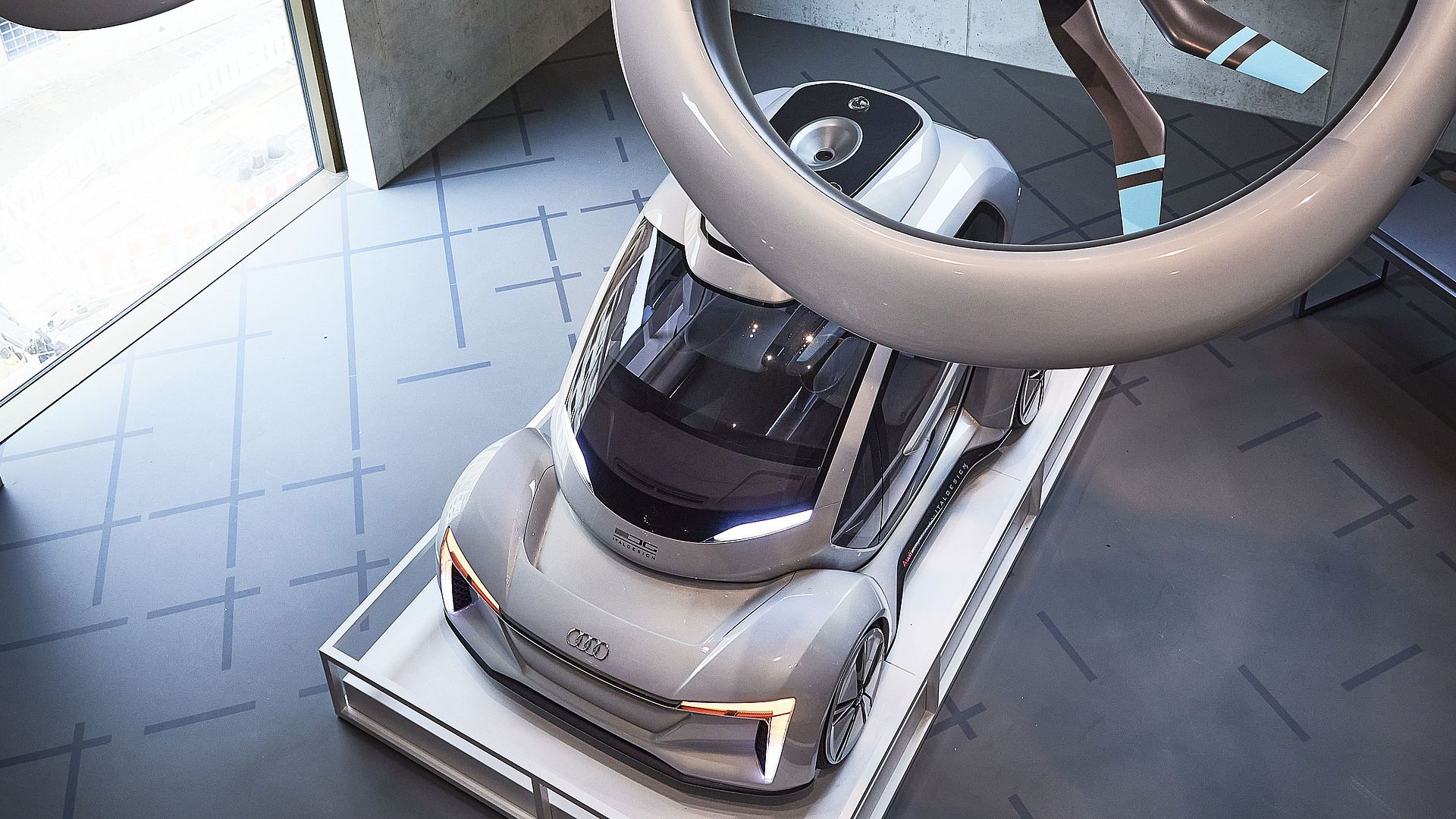
This network is not only made visible in the exhibition, but also ventures a look into the future. Prototypes such as the solar car "blue.cruiser" or the "Hyperloop" give an idea of what the transport solutions of the future might look like.
Insights
System City – How We Want to Live in the Future
More than half of the world’s population now lives in cities. By 2050, this could rise to around 80 percent – many of them in megacities with more than ten million inhabitants. Cities are growing, becoming denser and changing rapidly. But how does this affect our daily lives?
In the exhibition area “System City”, the city can be experienced as a complex system. This system consists of many interconnected parts: housing, energy supply, transport, water, digital networks and social spaces. When one element changes, it has consequences for all the others.
How much living space do people need? How can we use energy fairly? Who is entitled to use public space? And how can we safeguard quality of life in increasingly dense cities? The exhibition shows that the city of the future is not only a technical challenge. It is a task for society.
Urban planning always means making decisions
Who gets the space – cars or people? Who uses energy, mobility and infrastructure? How fairly do we share space? And how much do we want to rely on electricity, digital networks and AI systems?
Technologies such as automated driving, hydrogen and smart power grids are intended to make life in the city more efficient. But they raise questions of responsibility, cost and social justice.
“System City” makes it clear: technology alone does not create a fair city. What matters is how we use it and who is allowed to have a say.
Experience the city of the future
How does a city change when the power goes out for 1,000 days? What does public space sound like? And what happens when we are allowed to plan a city entirely from scratch?
The exhibition area combines models, real construction projects, interactive games and visionary ideas for mobility. Visitors build, listen, make decisions and experience how closely architecture, infrastructure and mobility are connected.
One model shows Germany’s first 3D-printed residential building. The 145 m² house was built in just a few weeks. 3D printing saves material and labour, but is currently still slightly more expensive than conventional construction. Around the world, the technology is already being used to create affordable housing. In the future, 3D printing could make construction faster, cheaper and more sustainable – buildings could be designed more individually and printed directly on site.
Further models illustrate emission-free buildings with intelligent light and temperature regulation, as well as bionic construction methods such as the “Elytra Pavilion”, whose structure is inspired by the wing of the Colorado potato beetle.
Historical urban utopias show that the idea of a better city is not new. It has accompanied us for centuries, but every generation has to rethink it.
The station “World without Electricity” uses three fictional scenarios to show what happens when the power is out for 1,000 days. Heating fails, communication falters, logistics and mobility come to a standstill. The installation powerfully illustrates our dependence.
Another station explains how green hydrogen is produced by electrolysis using renewable energies, and how it can be stored and used. Graphics show suitable locations for wind and solar energy.
The station “Megacities in Transition” shows how the centre of large cities has shifted over the course of history from Europe to other regions of the world – and that megacities will continue to grow.
How will we move people and goods in the city of the future?
CargoCap offers an alternative solution for urban freight transport: an autonomous transport system that carries parcels underground from the outskirts of the city to logistics centres. Research has been under way for more than 20 years, but implementation has yet to happen – mainly because it would require its own underground infrastructure. The idea shows how strongly new forms of mobility depend on technology, costs and political will.
New concepts are also being debated in passenger transport. The “CityQ”, a covered e-bike with plenty of storage space, is permitted in car-free zones and does not require a driving licence. It promises both comfort and sustainability. Yet the question remains: is it a genuine alternative to the car – or more of an “SUV among bicycles”?
The “Hoverboard”, known from the film “Back to the Future Part II”, lies somewhere between technological development and future vision. The film scene in which it floats makes the idea tangible and shows how strongly pop culture shapes our expectations of the future.
The station “Autonomous Driving” shows how far we have come today. Here, visitors can drive for themselves and experience how much training AI systems need in order to respond well in road traffic. An accompanying film explores opportunities, risks and the question of responsibility in automated transport.
In the area “Your Future Mobile”, visitors become designers themselves. Inspired by prototypes, science fiction and visionary concepts, they design their own means of transport. This makes it clear: the city of the future is not a finished plan. It emerges from ideas, debates and decisions.
Designing the city – getting involved yourself
In the game “Build Your City!”, visitors plan a sustainable city for 500,000 inhabitants. Infrastructure, electricity, mobility and leisure facilities all have to be taken into account. The aim is to increase residents’ satisfaction. But there is no perfect model. Every decision is a compromise.
The station “What Does Your City of the Future Sound Like?” makes it possible to hear how sounds shape the atmosphere of public spaces. Sound design unconsciously influences our mood and whether a place is perceived as lively or stressful.
Shared responsibility
“System City” shows that there is no such thing as an ideal city. Every solution brings new questions with it. Technology can help, but it cannot replace social debate. The exhibition invites visitors to look at their own everyday lives in a new way: How do we live? How do we move around? How do we use energy?
The city of the future will not emerge by itself. It is created through decisions. And we are all part of this system.