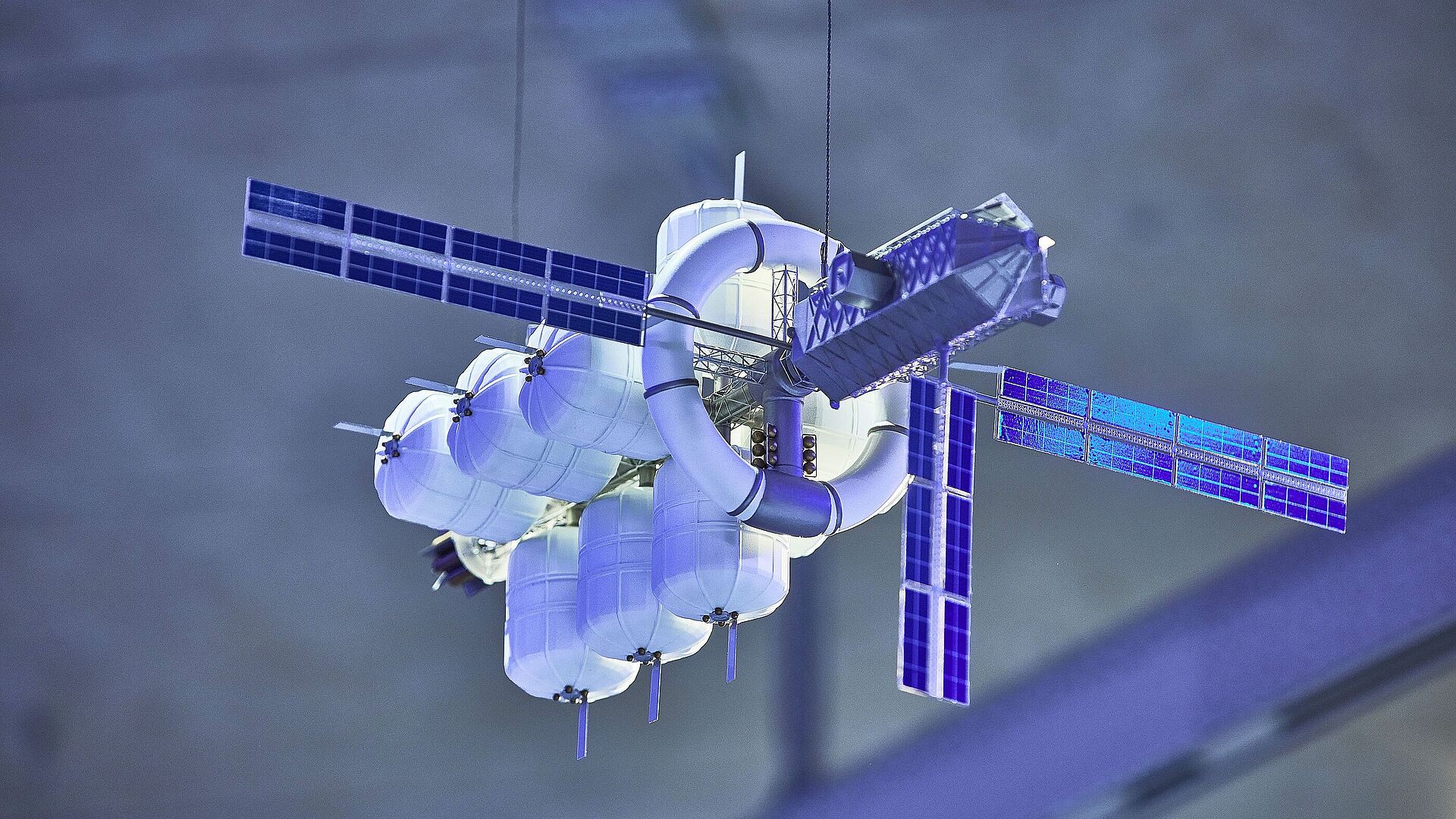
Photo: Deutsches Museum | Ludwig Olah
Space and Time
Ready for the Final Frontier?
An old dream is within reach: humans are using asteroids as a source of raw materials, colonising Mars and travel to distant galaxies.
But the human body is not made for life in space and not all technical questions have been solved so far.
Will we colonise space only with machines? An object that has already left the Earth once must therefore not be missing: The Soviet Foton 1 space capsule completed its unmanned, twelve-day flight through space back in 1985. The knowledge gained then still inspires the imagination today. Thus, ring-shaped space stations that can generate artificial gravity first appeared in science fiction. Today, NASA is actively researching their feasibility, as a model of the "Nautilus-X" space station shows.
Research is also being conducted into connecting orbital space stations via space elevators; initial developments such as the WARR can transport four times their own weight. How does it feel to steer a Mars rover on an exploration trip? The hands-on station reveals it.
Insights
Space & Time – how we explore, use and shape outer space
For thousands of years, people have looked up at the sky. Today, outer space is no longer a distant mystery, but a concrete field of activity. Spaceflight means launching rockets, satellites orbiting Earth, and probes leaving the Solar System. Alongside government space agencies such as NASA and ESA, private companies are increasingly moving to the fore. “New Space” describes this shift: spaceflight is becoming more economically driven, more diverse and accessible to more players.
The exhibition area “Space & Time” at the Deutsches Museum Nuremberg – the Museum of the Future asks: Will outer space become part of our everyday lives? Will the future be about research – or also about raw materials, tourism and new habitats?
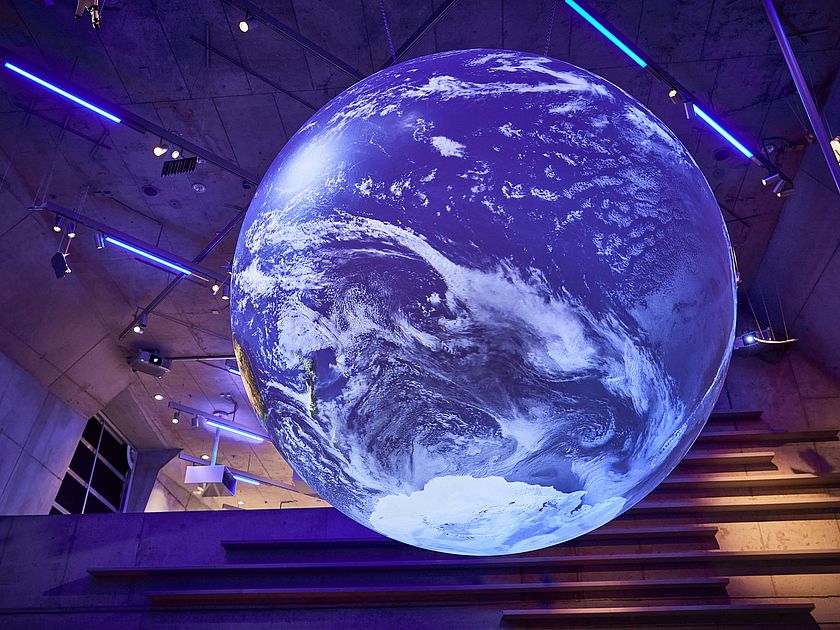
The Deutsches Museum Nuremberg shows how technology, visions and social questions interact. The design of the space underlines the theme: as visitors move through the exhibition, they symbolically move away from Earth – and then closer to it again. A balustrade overlooking the “System Earth” area is a reminder that all visions in space have their origins here.
At the same time, the exhibition makes clear what is already reality – and what still belongs to the future.
Who owns outer space – and who is responsible there?
As more and more countries and companies set out into space, one central question becomes unavoidable: who owns outer space? Who is allowed to use it – and according to which rules?
Earth’s orbit is already becoming crowded. Tens of thousands of larger pieces of debris circle the Earth, along with millions of smaller fragments. Who takes responsibility for space debris? Who is liable in the event of collisions?
The Moon, too, is once again coming into focus. Resources such as water ice and rare-earth elements are arousing economic interest. Will the Moon become a shared undertaking – or a new arena for geopolitical rivalry?
And if humans live permanently in space: what risks are acceptable? How do we protect body and mind in an extreme environment? How sustainable are energy and supply concepts beyond Earth?
“Space & Time” does not provide ready-made answers. The exhibition invites visitors to develop their own points of view.
From the Foton capsule to a Mars settlement – spaceflight at the Museum of the Future
Experiencing technology in orbit
Right at the beginning, visitors encounter a real piece of spaceflight history: an original Foton capsule, an unmanned Russian spacecraft that orbited the Earth for 12 days. Experiments with biological samples and crystalline materials show how conditions in space affect matter.
An augmented-reality space telescope makes visible what is orbiting above our heads: active satellites, space stations – and space debris. Additional information can be accessed via the virtual telescope.
Models and exhibits illustrate current developments:
- The CAESAR robotic arm, designed to service satellites and remove debris.
- FreeFlyer robots with gecko-inspired adhesive technology for capturing debris.
- NetSat, an autonomous satellite system that independently calculates orbital manoeuvres.
- First-MOVE, a CubeSat from the Technical University of Munich.
- The GRACE Follow-On mission, which measures changes in Earth’s gravitational field – important for climate research.
- Prototypes such as Climber last.minute and Climber one.third, which demonstrate new transport ideas.
A special experience: the simulated video call from the Moon to Earth. With a delay of around 1.3 seconds in each direction, visitors can sense what a distance of 380,000 kilometres means. For Mars, the delay would be up to 22 minutes.
The space-based solar power module presents a vision: collecting solar energy in space and transmitting it to Earth via microwaves – independently of weather and time of day.
Orbital Reef introduces a planned private space station as a possible successor to the ISS – an orbital business park for research and tourism.
Humans and the Moon – between vision and reality
A model of SUSIE, a reusable upper-stage spacecraft concept by ArianeGroup, represents Europe’s ambitions in space.
A playful element presents new crewed spacecraft, intended for moon missions, including Orion, Starship and Gaganyaan.
The Moon’s south pole is shown as a strategically interesting region – for example around Shackleton Crater. ESA’s “Moon Village” concept illustrates the idea of an international lunar base.
The question “Who owns the Moon?” becomes interactive: visitors choose future scenarios, vote using topic cards and can continue the discussion via QR codes.
In the museum’s drop tube, guests experience 1.5 seconds of weightlessness in free fall – under conditions like those on the ISS.
- Humans in space? – Life under extreme conditions
- How do people live far from Earth? A model of the Stanford torus shows a rotating space settlement with artificial gravity. NASA’s Nautilus-X concept demonstrates a modular spacecraft with a centrifuge for long missions.
- A diorama of a Mars settlement in Valles Marineris shows a fictional colony beneath a protective dome – with plant cultivation, 3D-printed buildings and vehicles.
- Mars exploration becomes interactive: in the simulated control centre, visitors steer a rover through a Martian landscape with a time delay.
Technology for the human body is also a focus:
- Alexander Gerst’s “Penguin Suit”, designed to counteract muscle and bone loss.
- Original space food (cheese spaetzle, sliced chicken in cream sauce, tiramisu).
- The Omegahab mini-ecosystem as a closed-loop life-support system.
- The “Phantom MARE: Zohar” model, which measures radiation exposure.
- The AI assistant CIMON, which was used on the ISS.
- A stress-management game simulates time pressure in space – inspired by a scene from the film Interstellar.
Infinite expanses – research beyond the Solar System
Here, the focus turns far outwards. At interactive stations, visitors discover exoplanets and learn how spectroscopy provides clues about atmospheres. ESA’s PLATO mission is presented as a planet hunter.
- A model explains how a Michelson interferometer such as LISA measures gravitational waves.
- Optical tweezers allow visitors to experience how light can exert force – a principle that also underlies light sails.
- One station illustrates Einstein’s idea of curved spacetime.
- Opposite this stands the “hyperspeed star destroyer” from Star Wars – clearly marked as fiction.
- And finally, the Fermi paradox: if the universe is so vast – where is everybody?
Between departure and responsibility
“Space & Time” presents concrete technology, real missions and visionary concepts. At the same time, the area makes clear that every decision in space begins on Earth. The exhibition at the Deutsches Museum Nuremberg combines research, discussion and experience – and poses a central question: how do we want to shape the next step into space?