Photo: Ludwig Olah/Deutsches Museum
Earth System
What Do We Do with the Earth?
New technologies will conserve the planet's resources while promising food for all, endless energy and control over the climate.
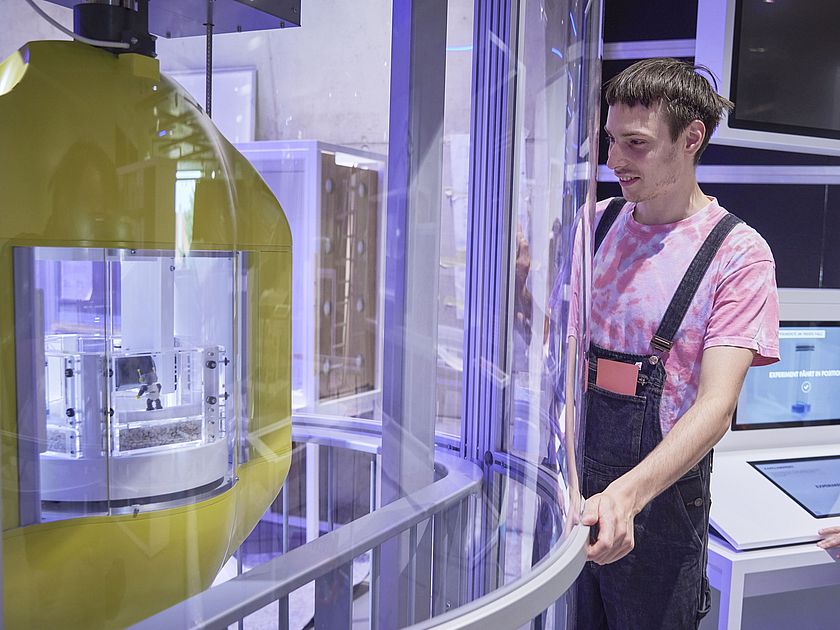
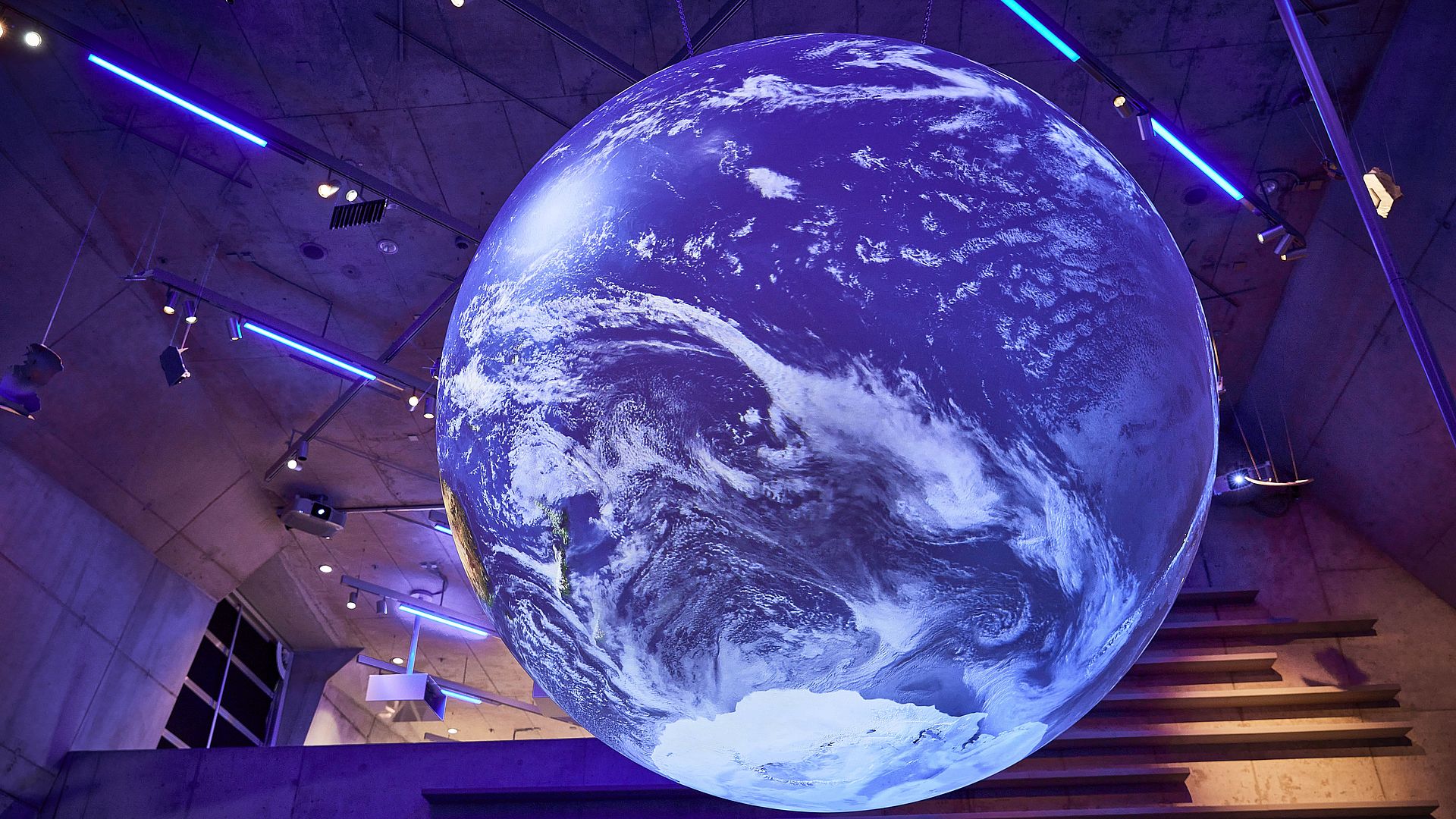
Yet the global population is growing and more people are orienting themselves towards Western lifestyles - the demand for raw materials and energy is increasing. This exhibition area shows technologies that could change the way we deal with the earth's resources: Food should be produced more sustainably, electric power should be generated without greenhouse gas emissions and raw materials should be recovered. The big picture is illustrated by a giant globe. Eight high-performance beamers use current data to make the Earth system and the traces our life leaves on the planet visible. So what can, what must and what are we allowed to do so that the Earth remains habitable? Exhibits, hands-on stations and installations such as the "rubbish mountain" brought to life by projection reveal uncomfortable truths and hold out the prospect of solutions.
Insights
Raw Materials, Nutrition, Energy – The Foundations of Our Modern Life
What connects streaming, smartphones and supermarkets? They only work because a complex system of energy, raw materials and global supply chains operates in the background. The System Earth exhibition area at Deutsches Museum Nuremberg makes this invisible network visible.
“System Earth” presents the Earth as an interconnected whole: climate, oceans, soils, raw materials, energy flows – and us humans as part of it. Yet human influence is now greater than ever before. Climate change, species extinction, the flood of plastic waste and overfertilized soilsprove it: We are living in the Anthropocene. Resources are limited, their distribution is unequal – and our everyday lives depend directly on them.
What does sustainability mean in concrete terms? And how fair is our access to System Earth? These questions are at the heart of the exhibition.
It is not about simple answers, but about connections – between technology, society and our behaviour.
Who Decides on Our Resources? Technology Between Opportunity and Responsibility
New technologies are intended to improve agriculture so that it can manage with less water, fertiliser and energy – while still producing enough. Yet every innovation raises questions:
- Who decides on the use of geoengineering or deep-sea mining?
- Who gains access to new foods or energy sources – and who does not?
- Should humans be allowed to actively intervene in the climate system?
- And what does global responsibility mean in an interconnected world?
“System Earth” shows that technology can help us use resources more sparingly or reduce greenhouse gas emissions. But it does not make decisions for society. The exhibition aims to stimulate discussion – not provide ready-made answers.
Thinking Along, Trying Things Out, Discussing – some Stations of “System Earth”
The exhibition area is divided into several thematic sections. Visitors encounter not only information, but also situations in which they can weigh up options, experiment and compare for themselves.
Food of the Future
At the staged dining table “Served Up!”, international cuisines meet sustainable innovations and science-fiction food. Algae burgers appear alongside insect protein and artificially produced laboratory meat.
At the station “Will Meat Come from the Laboratory in the Future?”, the focus is on cell-cultivated meat – meat grown in the laboratory from animal cells – in bioreactors. It is currently being developed by companies in countries including Singapore, Israel and the USA; regulatory approval for sale exists only in a few markets, mostly in the form of minced meat.
The “intelligent farm” shows how smart farming could use robots, drones and AI-assisted analysis to control harvesting, fertilisation and irrigation.
At the media station “Build a Vertical Farm!”, visitors adjust parameters such as energy demand or land use and discover how demanding closed cultivation systems in cities can be.
A projection featuring science-fiction scenarios contrasts these approaches with utopian and dystopian visions of the future that depict an apparently effortless supply of food.
Energy and Its Costs
How much energy does an online search or video stream consume? At an interactive station, visitors can “generate” the electricity consumption of digital activities themselves by turning a crank. Something that sounds abstract becomes a physical experience.
Alternative energy sources are presented through tangible examples: Orbital Marine Power’s “O2” tidal turbine uses the tidal currents off the Orkney Islands. A stellarator coil – a component from the “Wendelstein 7-AS” experimental stellarator fusion device in Garching – stands for the vision of nuclear fusion. This technology imitates the way stars generate energy. Yet despite major projects such as ITER, it has not yet been possible to make nuclear fusion economically viable. Here, too, the exhibition invites reflection: how would unlimited energy change our society?
Making the Earth’s Climate Visible
A three-metre globe forms the centre of this area. Eight projectors cast a nine-minute sequence of global changes onto its surface: clouds move, seas warm, cities grow, light pollution increases, CO₂ and nitrogen dioxide spread, and much more.
The projections are based on satellite data and model calculations, created in collaboration with the German Aerospace Center (DLR). An interactive station beneath the globe explains the data sources and background.
The “Twin City” graphic shows how Nuremberg’s climate could develop by 2070 – resembling that of Marseille today.
Another station highlights geoengineering experiments currently taking place around the world, based on data from the “geoengineering monitor”.
The historical “Atlantropa” project illustrates how visionary, yet at the same time controversial, large-scale technological interventions in the environment and climate can be.
Raw Materials, Cycles and Waste
A lenticular image shows how many everyday objects would disappear without raw materials such as cobalt, crude oil or sand – leaving behind only a natural cork.
At the “Recyclebar”, visitors learn which materials can be recycled well, such as pure aluminium, and where the limits lie, for example with wind turbine rotor blades.
The “Patania II” prototype embodies the idea of extracting manganese nodules from the deep sea. Yet the consequences of such interventions for ecosystems that have hardly been studied remain uncertain.
At the end of the area rises the “mountain of waste”. It shows the growing quantities of waste – from plastic and electronic scrap to food – and asks: what happens when cycles fail?
Responsibility in System Earth
“System Earth” connects food, energy, climate and raw materials within one larger context. The exhibition presents technological solutions – from the “CloudFisher” fog collector for obtaining drinking water to innovative filter systems designed to counter water scarcity – and places them within a social framework.
The focus is not on how we “save the Earth”, but on how we secure the foundations of our lives. For ourselves and for future generations.