

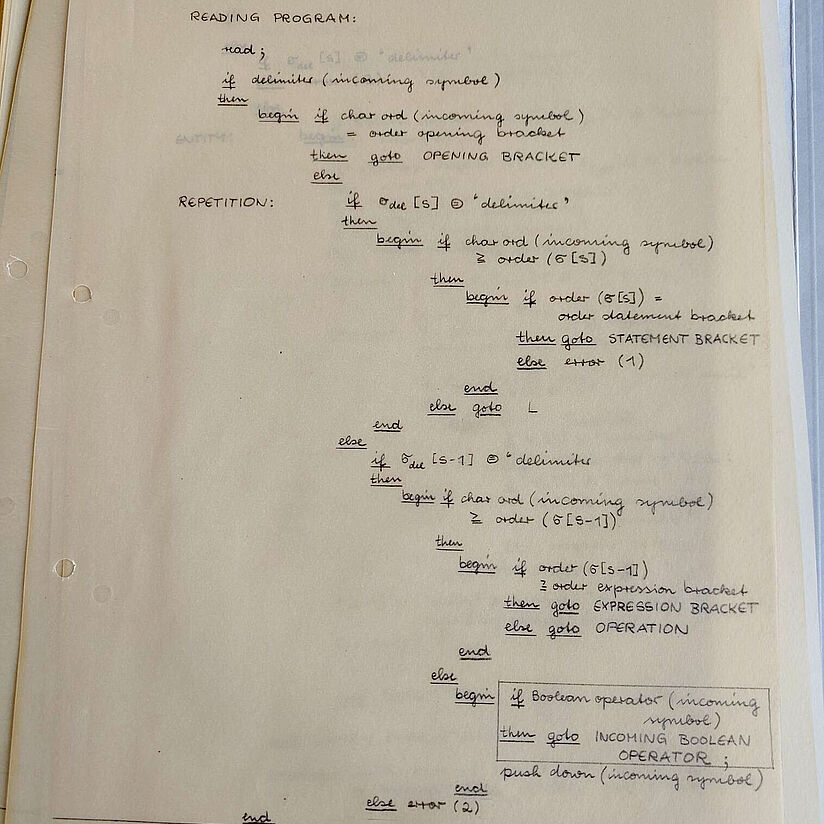
Handwritten programming work by Ursula Hill (later Hill-Samelson) on the "ALCOR S 2002 Model Translator," an ALGOL 60 compiler for the Siemens 2002 computer system developed by Hill and Hans Langmaack in 1962. The logical structure, visualized through indentation, is clearly recognizable. The pseudocode written by Hill had to subsequently be translated by hand into assembly language and transferred onto punched paper tape to be machine-readable. Photo: Deutsches Museum
Digital cultures of technology and knowledge
Edition of Scientific Software (Munich Research Unit)
The history of scientific software remains an under-researched chapter of the history of science and technology. As an instrument of scientific inquiry and part of our digital cultural heritage, its historical sources are at risk of being lost. As part of the 21-year Academy project “Edition of Scientific Software (EWS)” (2026–2046), the Munich Research Unit at the Research Institute of the Deutsches Museum investigates the historical foundational layers of scientific computing through four key case studies.
Content
EWS Munich Research Unit – Foundational Technologies of Scientific Computing (Research Institute of the Deutsches Museum / LMU Munich)
Funded by
Union der deutschen Akademien der Wissenschaften
- Digital cultures of technology and knowledge
Edited by
PD Dr. Ulf Hashagen
Leitung Hauptabteilung ForschungsinstitutProjektleiter des Projekts "Edition wissenschaftliche Software" (EWS)
Prof. Dr. Helmuth Trischler
Senior Researcher, ehemaliger Bereichsleiter ForschungWissenschafts-, Technik- u. Umweltgeschichte
Dr. Andrea Reichenberger
Leiterin Projekt EWSForschungsinstitut
Dr. Stefan Esselborn
Wissenschaftlicher Mitarbeiter im Projekt EWSForschungsinstitut
Project description
Nearly every modern scientific discipline is now digitized. Computer simulations, mathematical models, and algorithms shape central processes of knowledge production. Scientific software is both an indispensable research instrument and part of our digital scientific and cultural heritage.
Due to technological obsolescence, outdated hardware, and deteriorating storage media, this record is at risk of being irretrievably lost. EWS addresses this gap by systematically identifying, archiving, and critically editing scientific software from 1950 to 2010.
Focus Munich: Basictechnologies
The Munich Research Unit systematically explores the historical layers of Scientific Computing through four foundational case studies:
1. ALGOL: Algorithmic Language
Preservation and documentation of the development and implementation of ALGOL (especially ALGOL 60), a pioneering programming language for scientific-mathematical calculations.
2. Computer Algebra Systems (CAS)
Historical study of the emergence and development of software systems for the symbolic and algebraic manipulation of mathematical expressions.
3. Finite Element Methods (FEM)
Research into the evolution of software and numerical methods for solving complex physical differential equations in engineering.
4. Computational Fluid Dynamics (CFD)
History-of-technology analysis of the development of simulation software and algorithms for numerical fluid mechanics.
Research design & methods
The interdisciplinary research design combines three complementary methods:
• Archival Research: Consolidation of disparate, scattered manuscript and digital sources across institutional and private archives (esp. the Archives of the Deutsches Museum).
• Oral History: Semi-structured interviews with historical software developers and key players to capture informal practices.
• Participation: Exploration of participatory approaches to identify and contextualize previously unprocessed holdings.
Official Project Website:
www.edition-software.net
Note: For comprehensive information on the overall project management and the other research units in Aachen (RWTH Aachen) and Bielefeld (Bielefeld University), please visit the official project portal
Links
Logos of participating Academies and funders
Further links
Offizielle Projekt-Website (EWS Gesamtprojekt)
https://www.edition-software.netForschungsinstitut des Deutschen Museums
https://www.deutsches-museum.de/forschung/forschungsinstitutSoftware Heritage Archive
https://www.softwareheritage.orgSoftware Metadata Preservation Network (SMRF)
https://www.softwarepreservationnetwork.org
![[Translate to English:]](/assets/_processed_/c/c/csm_Headerbild_Chiffriermaschinen_Rainer_3889c3d7be.png "[Translate to English:]")
![[Translate to English:]](/assets/_processed_/f/1/csm_Forschungsinstitut_Projekt_Algorithmische_Wissenskulturen_Header_HashagenSeising_743a1da746.jpg "[Translate to English:]")
![[Translate to English:]](/assets/_processed_/9/4/csm_Forschungsinstitut_Projekt_Zuse_Headerbild_CD_57903_5bb36f91cf.jpg "[Translate to English:]")