
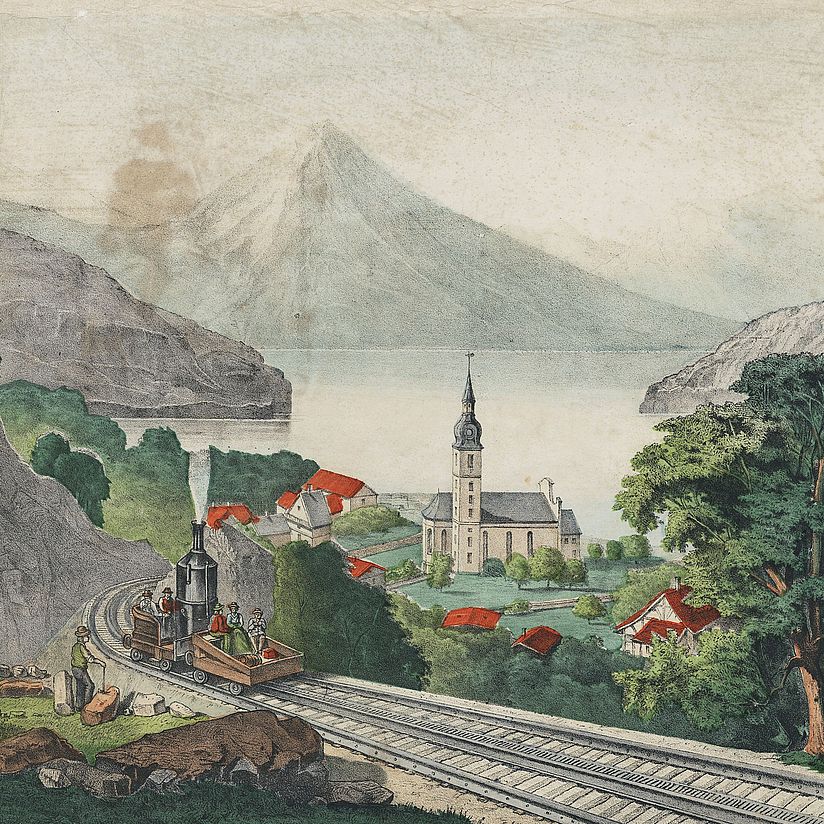
Photo: Deutsches Museum
Collection of artworks
As a typical collection of the Deutsches Museum’s masterpieces of science and technology, the prints primarily depict scenes from the history of the various technical disciplines.
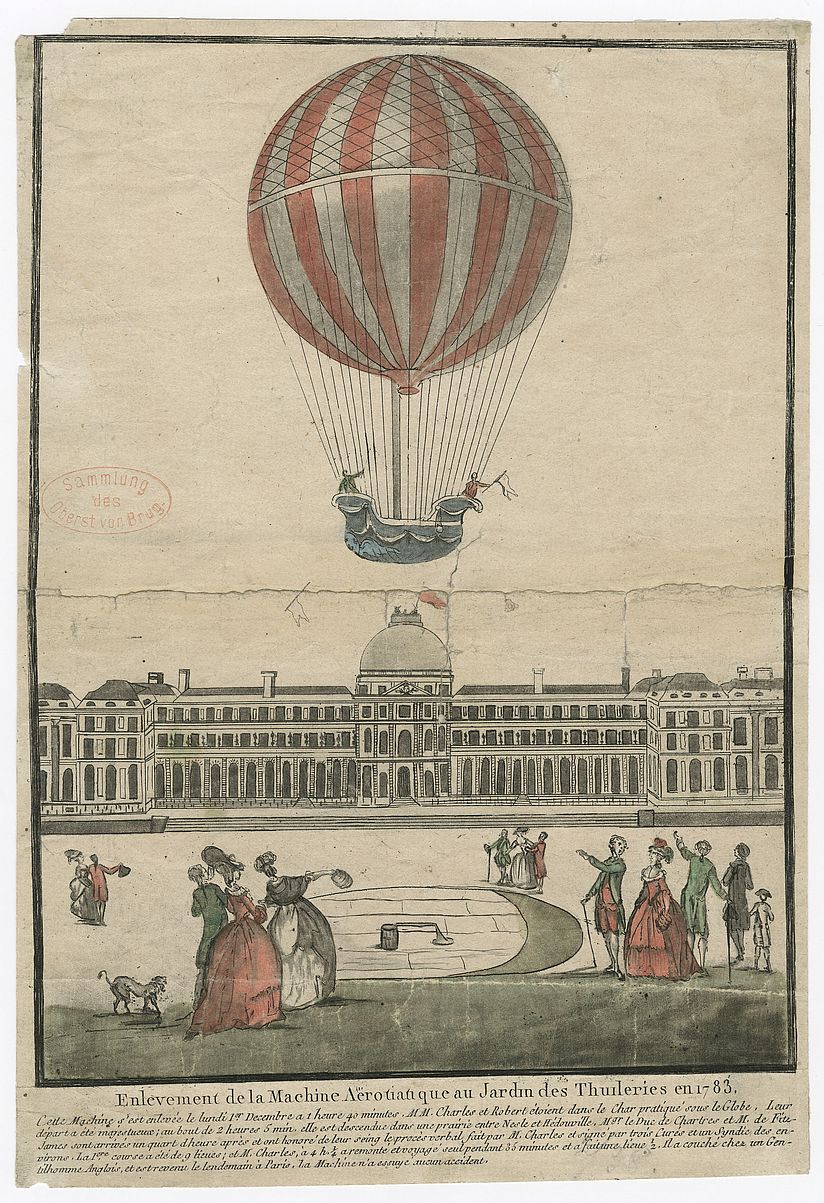
Aufstieg von Jacques Alexandre César Charles und Marie Noel Robert in den Pariser Tuilerien, August 1783. Aquatinta, koloriert. Signatur: GS 00015. Photo: Deutsches Museum
Pictures of technical innovations
In the early years of the Deutsches Museum, technical drawings, plans, display panels, prints and posters were all stored indiscriminately in the plans collection. For some years now, these categories have been separated and the items catalogued individually.
The prints and drawings collection comprises hand-drawn sketches, watercolours and almost all forms of printmaking (copperplate, woodcut and steel engravings, etchings and lithographs). Posters and portraits are housed in separate collections.
In many cases, the prints were used for exhibitions at the museum, where they illustrated the development of craftsmanship and technology. A number of prints reflect the reactions of contemporaries to technical innovations: admiration, but also scepticism and fears. Typical examples of this are caricatures, which were widely circulated as single sheets or in periodicals. Purely artistic depictions are rarely found in the collection. Chronologically, the collection begins in the early 16th century, but its main focus is on the period between 1800 and 1900.
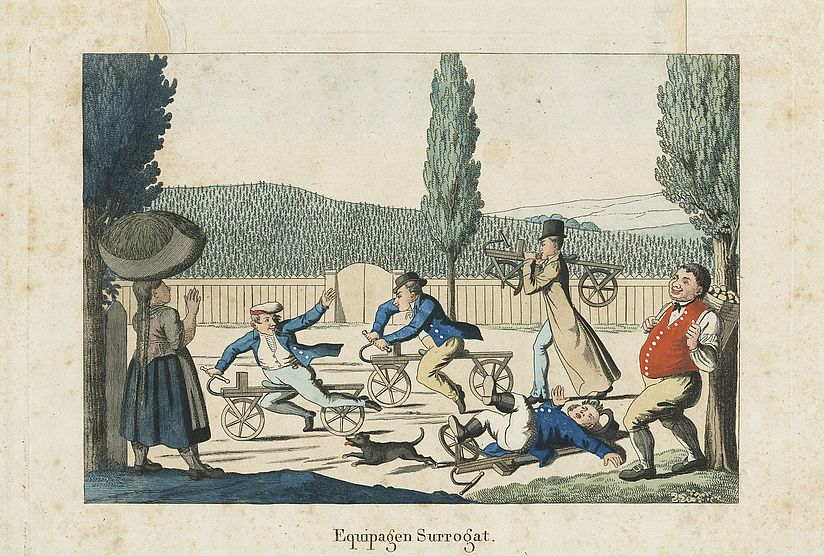
English caricature of the velocipede, c. 1819, Call Number: GS 00720. Photo: Deutsches Museum
Many of the sheets were purchased from second-hand bookshops. Some were cut out of books, though these are usually difficult to identify. Numerous plates are taken from the standard works by Christoff Weigel (1698), Paul von Stetten (1779) and Émile de La Bédollière (1842). In 1905, the Bavarian general and ‘pioneer of aviation’ Karl von Brug (1855–1923) donated his valuable collection on the history of ballooning to the Deutsches Museum.