
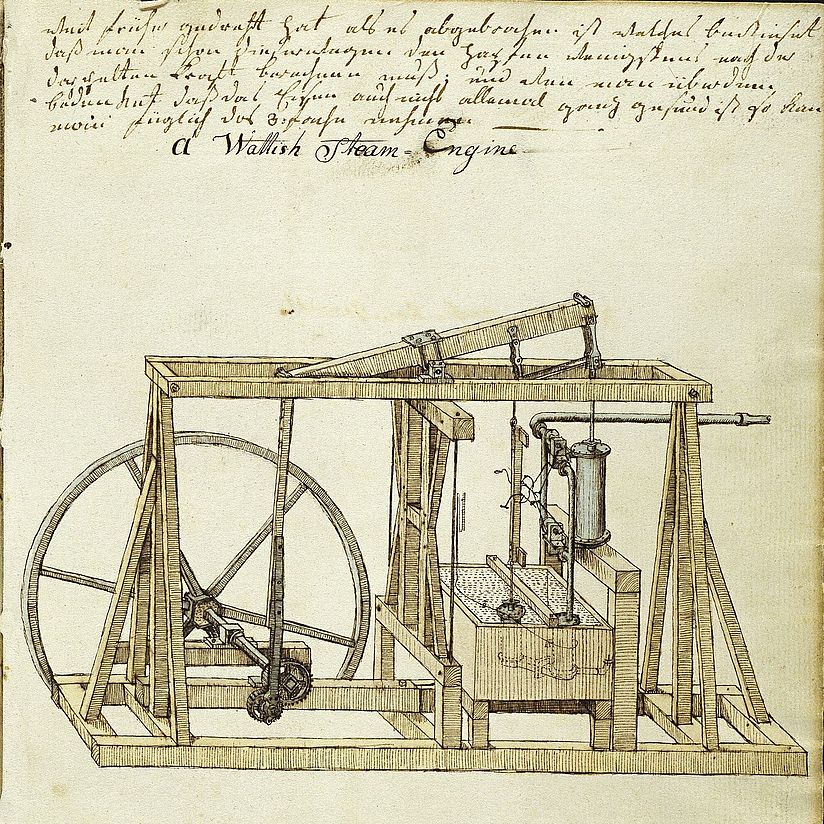
Photo: Deutsches Museum
Manuscripts and Documents
The collection of manuscripts and documents is the oldest and most valuable part of the Archive. In total, the Archive holds around 15,000 individual manuscripts by prominent scientists, technicians, inventors and engineers, spanning the entire spectrum of scientific and technological research.
Albertus Magnus „Physicorum Libri VIII“, 1. Seite, Pergamenthandschrift, 2. Hälfte 13. Jahrhundert, Signatur: HS 2008-12. Photo: Deutsches Museum
Berechnungen zur Entdeckung der Kernspaltung, durchgeführt von Otto Hahn und Fritz Straßmann, 17.12.1938, Signatur: HS 1960-15. Photo: Deutsches Museum, BN 51690
From the 13th Century to the Present Day
The 'Manuscripts and Documents' collection is an artificial collection of individual items that bear no direct archival provenance to other documents. The material includes letters, postcards, manuscripts and typescripts, calculations, bound handwritten volumes (lecture scripts and lecture notes, notebooks and diaries, laboratory journals), as well as diplomas. Chronologically, the manuscript collection of the Deutsches Museum spans from the thirteenth century (the Albertus Magnus Codex) to the contemporary era, with the primary focus on the nineteenth and twentieth centuries.
The roster of prominent figures extends from Michael Faraday (1791–1867), Justus Freiherr von Liebig (1803–1873), and Werner von Siemens (1816–1892) to Marie Curie (1867–1934), Albert Einstein (1879–1955), Otto Hahn (1879–1968), Georges Köhler (1946–1995), and Klaus von Klitzing (b. 1943).
For several years, complete personal papers originally integrated into the manuscript holding have been undergoing retro-conversion to restore their original context of creation, being catalogued and shelved as distinct, closed collections of personal papers.
Key Thematic Areas
Abbildung des Bergbaus am Falkenstein aus dem Schwazer Bergbuch, Illuminierte Handschrift, ca. 1550. Signatur: HS-1971-1. Photo: Deutsches Museum
- Physics
- Chemistry
- Astronomy
- Mining and Metallurgy
- Electrical Engineering
- Geology
- Mechanical and Instrument Engineering
- Mathematics
- Pharmacy
- Transport